- Slides
- Transcript
- About the Speakers:
Mark Stephens, Chika Emebo
and Nadir Shah - Join the BoS community
There’s a right way and a wrong way to build a software company. Is there though? Mark (along with people on his team who were not even born when he started IDRSolutions) will share their heretical views and aim to challenge you in the hope you will strongly disagree on at least one thing.
IDRsolutions has been around for 25 years. They are life-long learners (which is why they keep attending BoS) but have also formed strong views. In this talk, Mark challenges your views and make you think about how you run your software business. He shares how BoS talks have helped him tackle topics including size, money, hiring (no received wisdom is going to be sacred) and explain how IDRSolutions approached these problems.
Slides
Find out more about BoS
Get details about our next conference, subscribe to our newsletter, and watch more of the great BoS Talks you hear so much about.
Transcript
Chika Emebo
Hi, everybody. I’m Chika Emebo.
Nadir Shah
And my name is Nadir. You can probably tell by the dress I work in marketing.
Chika Emebo
And since Mark hasn’t showed up, today, we’ll be taking over. So today we’re going to be talking about money, growth and scaling, hiring and culture, change and the future, Q and I, not to be confused with Q and A, so questions and ideas. But first…
Nadir Shah
So in the early days of BoS, or the early badass days of BoS, you had Lightning Talks, or you’d call them Pecha Kucha. So with those, you’d have 20 slides and you’d have 20 seconds each for those slides, and there was absolutely no mercy. So before we go on to the lightning talks, let’s take it back to 1999…
Mark Stephens
Thank you. So sorry I was late. I was never going to miss my own talk. We practiced it on, 20 seconds. Okay, so let’s go.
1999: Setting The Scene
1999 was a very different year. We had lots of really crap Star Wars films being produced. We had the government trying to fix the health service. We had arguments over Europe, and all these well paid software developers were writing they replaced by some alternative that’s going to put them out of a job. Most of all, we had this amazing and this is going to be hard to understand in 2025. But most of all, we had this amazing trend where lots of businesses persuaded lots of venture capitalists to give them huge amounts of money when they had absolutely no business model. Wouldn’t happen in 2025, but it was good times, and the aim was to sell shovels to these people and make as much money as possible.
Mark’s Early Life & First Signs of Being a Tech Nerd
I first realized a bit of a technical nerd when a local musician organized a big party and invited the entire neighborhood to it. Paul, George and Ringo got up on stage and performed a couple of songs by a band you might have heard of called The Beatles, who broke up 10 years before. Everyone was there. My dad said it was an amazing experience. A very young Stella McCartney was dancing on the stage. They were there. Eric was there. Obviously I wasn’t there because I was in the room with the free space invader machines. Imagine it, chance of a lifetime. You didn’t have to feed 10 peas into these machines. I had my name on the high score table for every single machine in that room. Absolutely incredible. And I’m very proud, as a technical guy, to say that’s where I was.
Career Path Before Entrepreneurship
I followed the usual career path, I went to study medieval history at St Andrews University for four years, which involved eating lots of donuts and playing lots of sport. My family will tell you, I’m very proud that I won my event at the Scottish university of Athletics Championships, and have been telling them ever since. And I got to university blue. I went to Loughborough to do more sport. Then I went and worked at a prep school for five years, which is a really good experience. Then I decided I should get a proper job. So I went to work for Unisys, who were putting in a new publishing system for Rupert Murdoch’s papers. I also thought I’d better get a proper degree. So I went to Greenwich to do an MSc in computing, and I started writing some software. And actually I thought News International will need this software in five years, in a couple of months time. And I told Unisys that I’d written the prototype, and I thought they could sell them. You probably see where this talk calls going.
Anyway, Unisys were a very bad company to work for. The publishing team actually left and set up a very successful company called Eidos media, working for the FT. I went to London Transport. I sadly didn’t have my own bus. I worked in the DBA Association, and I was in Victoria library, doing my coding as you can probably imagine.
Founding Story: News International & Story Pad
Soon as I left Unisys, I got a call from the CTO of News International, saying, we’d like to be your first customer, and this is actually our contract. My daughter was six months at the time. I made the mistake of putting it on the table and as you can see, Izzy signed it, and I have this on my wall to this day. If I ever take myself too seriously, I always look at that.
So the product we built for News International, we called Story pad. It allowed them to extract the data from the publishing system and put it into a vignette database. It turned out to be a one product company. Sorry, one company sale, we did try and sell the idea to vignette, but we written a little PDF library to do it.
Pivoting to a PDF Product Business
So what we did was we turned that into the more generic product. I think it’s called pivoting these days, but every company’s first product is always generally a disaster, and we built a whole range of customers. These are customers we have or have had over the last 20 years. What we were doing is solving their PDF display problems. These days, the only people doing Java apps are German banks. Everyone’s converting PDF to html5. So that’s what we’ve done. We built the stack on it. We own the tech, and we’ve kept it deliberately small.
And I’m telling you about some of the more interesting customers that we’ve had, or what’s interesting, I think, for you guys to learn about it. First of all, iText is a big, big Java library. They actually white labeled our PDF library. If you use our PDF viewer, it’s actually our stuff under the code. They tended to zig when we zagged. So they tried to do a high growth VC backed base. And if you read Bruno’s book, it’s really interesting. I was obviously quoted. I actually employed 13 people, so I need to correct Bruno’s quote.
We did a lot of work with a Swiss company called Abacus, which, again, if you don’t think you can bootstrap a company. Three guys, last year, they turned over 100 million they have 60,000 customers. They employ 600 people, and they have a very nice restaurant overlooking St Constance and St Gallen. That’s been a long term relationship with us, and that’s generated millions of revenue for us.
My favorite clients, Adobe. We sold snow to Eskimos. So Adobe bought our PDF library. And this is the classic build versus buy dilemma. I think Adobe could have probably built a PDF library if they wanted to, but they needed to integrate it into cold fusion. And this is the problem a lot of our customers, as in your customers as well. Face is, do they do it themselves, or do they buy it?
Last month, we were seeing one of our newer customers Academia in San Francisco. We went there to do a customer interview. Bob, I hope you know, we’ve been playing attention in class. And one of the interesting things they said was they had deliberately chosen us because we were a small company. We weren’t PDF, Tron, who are the big 100 million dollar VC backed one. They thought we could do better service, and Chika did her customer interview.
What We Learned Early On
When we started, there was no one to tell us all the things to do, so we had to work it out ourselves. I read a lot of books, I made a lot of mistakes, I learned a lot of things, and that’s what I’m going to share with you guys for the rest of the talk, and we’re going to educate, hopefully have an interesting discussion on it.
So I’m going to introduce you to some of my favorite books. I love this book. This book is three MBA professors get in a slightly battered car, and they drive around America going to other businesses and seeing whether actually the stuff they teach their students at great expense at Stanford, Princeton, Kellogg, I think they currently are at is actually any use. And you’ll have to read the book yourself if you want to find out the answer to that.
Strategic Thinking: “It Depends”
One of the guys in it is a guy called Mike Mazzeo, and this is what we struggle with every day. The answer to every strategic question, is all together, “It depends!” Thank you. And if the answer isn’t it depends, it’s not a strategic question. So that’s the challenge we get, and that’s why we come to Business of Software.
Business of Software & 25 Years of Lessons
Business of Software has been a really important activity in my life, and I’ve learned a lot of it. And I’m going to share a lot of the talks. This was one of the early talks. I’m not sure what this guy’s talking about. If I ever meet him, I’ll ask him. There’s some spanner in a bath surrounded by rose petals. I think it’s about the dangers of using AI to generate images for your talks. If I ever meet him, anyway, I will ask him. But Business of Software has been an amazing experience, and my favorite part is the hallway track. So I’ve been thinking, because I’ve been doing this for 25 years, if I get the DeLorean and I get to go back to go back to 1985, probably because that was when the best music was. But I might go back to any time, what would I tell myself? And that’s what I want to share with you guys in the rest of the talk. So what would Mark, age 56, go back and tell his younger self?
Well, first of all, I would tell him that if he’s going to dye his hair as a charity stunt, then he needs to remember the eyebrows, because he’s going to look really stupid in the pictures. But above all of that, I think that there isn’t really any advice we give to ourselves. I think the fact we’ve got here is a good sign. I think unfortunately, they have to take the long road. I think we spend too much time looking for a shortcut, and unfortunately there isn’t a shortcut. There’s just learning and taking the learning away from him. So I’d say, keep on going with the running, sort out the eyebrows, and yeah, I’ll see you at Business as Software in 2025.
So thank you very much for listening to my lightning talk.
Setting Up The Main Talk
So we’re going to slow the pace down a bit, because I certainly couldn’t do this for an hour, and I don’t think you guys could take it either. So we’re going to cover an awful lot of ground. We’re going to talk about a lot of stuff that’s interested us, stuff we’ve learned from Business of Software. We don’t want you all to be sitting there writing notes. We want you to engage with the class. Remember, I’m an ex teacher, so I will be watching, and there will be punishment afterwards for anyone I feel is not paying attention. Ritual humiliation always works, believe me.
So what we’ve done is we’ve got a page on our website. We’re going to give you the link at the end. So please don’t feel you need to snap something if it’s of interest, we’ve got the page. You can go to it, and we’re going to tell you some of the talks, some of the interesting things we’ve learned. I hope you will disagree with some of what I’m saying. That’s what Business of Software is all about. If we all agreed and there was a simple playbook, we’d all just follow that, but it isn’t. As Mike Mazzeo said, It depends. Thank you. So as I said, there will be a URL with the links, so there will be homework, and it will be set at the end, so don’t worry about it now.
So first of all, I’d love to talk about money, and I’m getting good some quotes from some interesting people. Dharmesh Shah is a very smart, very eloquent and very sadly, not regular enough speaker at Business of Software. And he said venture capital is neither evil nor necessary. It’s a tool like any other tool, and we shouldn’t get obsessed about it. I love this quote from, anyone know what film it’s from? Wall Street, excellent. Greed is good. If money is your main motivator in life, my view is good for you. We need people like you to generate wealth, taxes and jobs. I think we get hung up on that sometimes. One thing I have learned is whatever we are, we should absolutely own it, and we should make it our superpower. If money motivates you, that’s fantastic. Go out and create some jobs, make lots of money, and I want a percentage for giving you the courage to do that.
Money
So our viewpoint on money, and again a lot of these things, we’re not saying what’s right. We’re not saying what’s wrong. As the guy said, it’s a Q and I session, you have the answers, and the answers will be different for each of you. But our viewpoint is, first of all, it’s a very emotive issue. You get some people who come here as a bootstrapper, and then 10 years later, they come back and explain why they’ve sold from their company for 50 million. And there’s a slight sort of our view is very much Keynes. If the facts change, you change our opinion. So if you’ve taken lots of money, congratulations. If you haven’t taken lots of money, congratulations. Whatever works for you.
There are some big problems that need a lot of money. But it is the case that when I started in 1999 if you wanted to run an internet company, you ran Sun Microsystems. Anyone remember Sun Microsystems? All the people with gray hair or no hair, put their hands up. Thank you. You would go and buy a big, expensive box from them. You’d plug it into the internet. So you guys who are starting your company now, your costs are far, far lower. Everything’s virtualized. Everything’s available on demand. You don’t have to buy it. You can essentially buy it as and when you need it. So you spend a lot less money.
I generally think your view to money is whether you are what I’ve called a commercial mission or product company. So if you’re a commercial company, ultimately you’re there to make money. All companies are there to make money. It’s what priority that is in your agenda. A mission company is something like London Transport where I worked, or the school where I worked. They get a budget, and their job is to do something. They don’t overspend their budget, but if they only spend 50% of their budget, they’ll be in trouble, because they’re probably cutting lots of corners. If you’re a mission company, money is less important in terms of how much.
Lastly, there’s what base camp likes to call themselves. Is the product company, to some extent, the company, extent, the company is the destination, and that will influence what you do or what your views are. And again, whatever you think is cool, that’s Business of Software. We like to think of it as something you do, like breathing. As a small company, we need to make money all the time, but it’s not something we spend our life thinking about or fixating about, but it is critically important, and we do need to do it.
So the best bit, BoS talks you need to watch. Nobody knows these in advance, but I do have some that I think will surprise you.
First of all, Dharmesh Shah did a brilliant talk about building a software company, and he explained how HubSpot essentially makes a loss on all of their customers for the first eight months. So if you want to get a million customers, and it costs you $1 a customer, or whatever, a month, you need $8 million just to not go bankrupt. So that’s one reason why you would need to raise lots of money. And he does it brilliantly. On a lot of these slides, I will have a TLDW. If you have Gen Z people working for you, or you have kids of that age, you will know that TLDR means stands for too long, didn’t read. And we put it on our discussions as a summary. So TLDR is didn’t watch, So that’s the TLDW for you.
A slight variation is Chris from Wistia took a whole lot of investors, and it turned out they were interested in going to different places. So he bought out the investors, and he ended up taking the company to where he wanted to go. So again, he found there’s no such thing as a free lunch in life. You always have something. So the key point from his talk is to like, first of all, accept that, and if you get it wrong, have the courage to change direction.
Why IDR Never Raised Money
So why haven’t we taken any money? Well, first of all, we didn’t need to, if you’re reading carefully. I was working in Victoria library until Uncle Rupert gave me 75,000 pounds, and we’ve been profitable ever since, and we haven’t had any huge problems we’ve needed to solve. So we haven’t needed to borrow any money. Again, we’re very much the second mouse gets the cheese. We think of all these big first mover companies, like, who’s heard of Myspace? AltaVista? Okay, yeah. So unless you’re around at the time, they’re like, long, dead and buried.
So first mover advantage, in my opinion, is underrated. Get the cheese. Also, if it’s my money, and just to be clear, it is my money, guys. So you spend it, you spend it carefully. It imposes a discipline that we think carefully about it, and I think that’s important so we don’t spend more than we need to. But equally, we’re not skinful insider. I did let you actually hitchhike today. Also, we’re not in the financial engineering game. We’re not trying to do any clever leverage. We leave that to the financial guys. We’re a software company. That’s what we do.
And also, we think that essentially allows us to have a different group, or a smaller group of people who we care about. The more groups that we have as stakeholders, the more trade offs we have between them. If we had external investors as well, we’d be trying to balance them. But to us, what’s important is customers and staff.
Growth
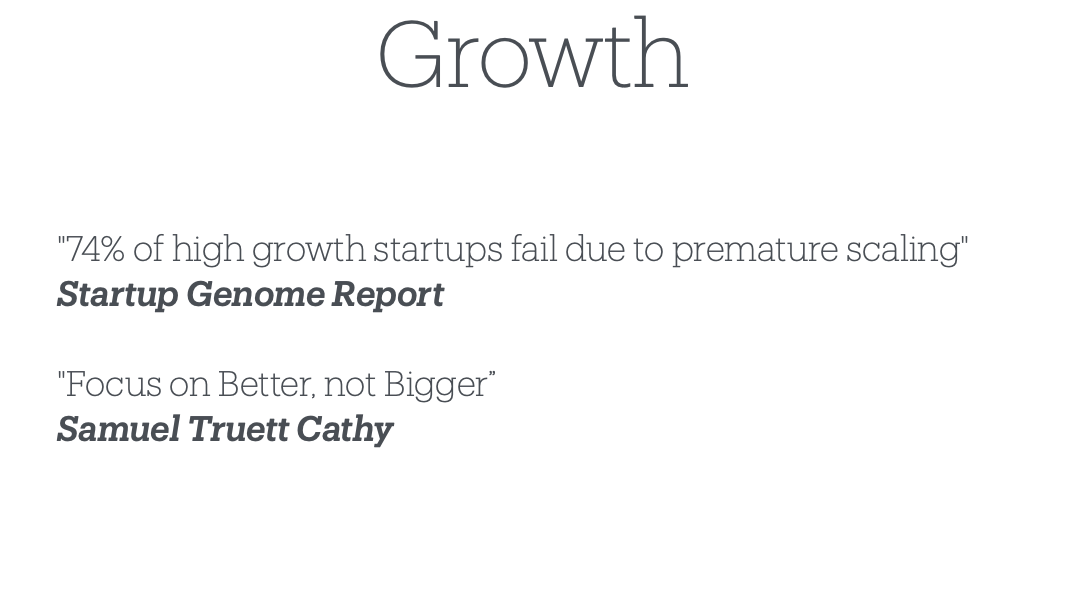
So, growth. For a lot of people, growth means getting bigger, hiring lots of people, getting big offices, running up huge debts. I’ve got a scary figure for you here. I like to have scary figures. I’ve got some scary figures and some scary graphs. Every BoS talk should have both of those. So first of all, 74% of companies go bust, not because they’re unprofitable, but because they try to scale or they miss scale it so they create costs faster than they create value, or they generate money, or they run out of cash because they just burnt through it. So there are a lot of companies around that could have still been here if they hadn’t been in such a hurry to be the next Facebook. So we focus on better, not bigger. And that’s going to be a theme that’s going to be going through the talk.
Hockey-Stick Fantasy
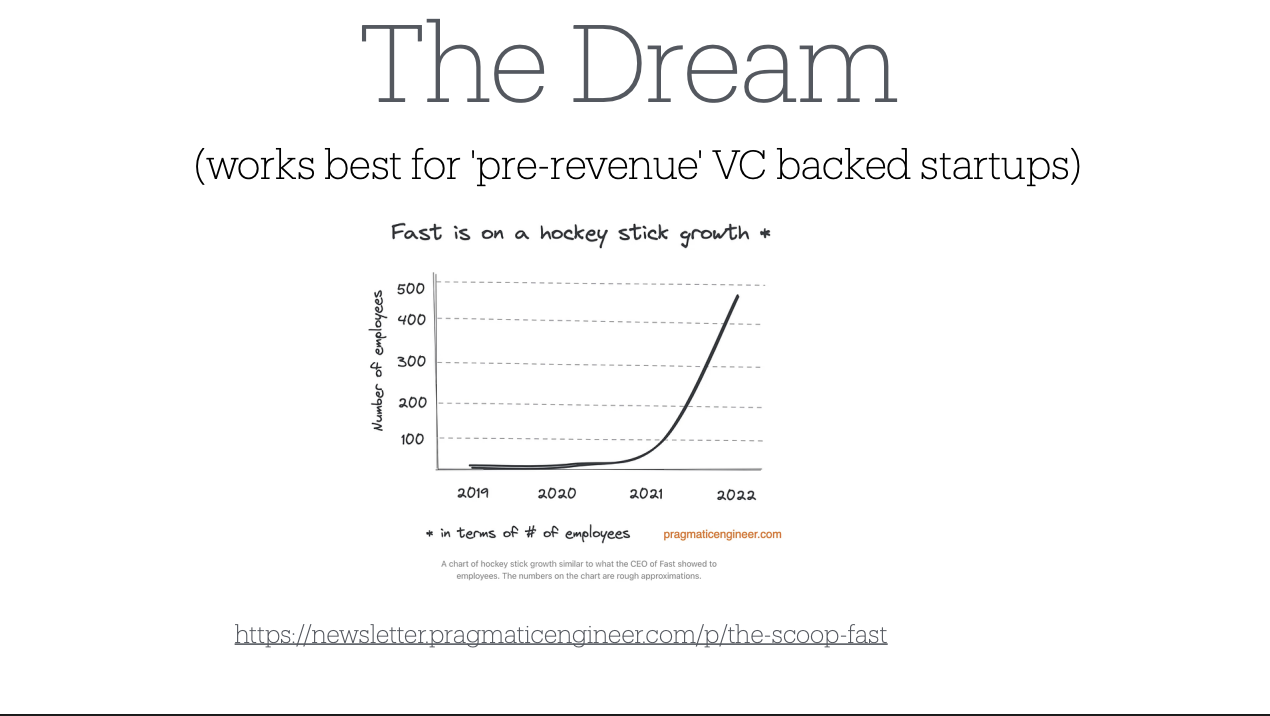
This is the dream. And again, as I said, this is highly pre-revenue. Because when you’re pre-revenue, you can make all sorts of big claims and pretend that, like, you know, your market is Chinese people or dead people. There’s a lot of dead people out there. So if 1% of dead people buy our product, then you know, we’re going to make a huge killing. And you get this classic hockey curve. This is actually from a real company, but it’s not their sales, it’s actually their costs and the number of employees. You may have heard of this company. It was called Fast. It was when it finally went bust, it was burning 10 million a month in terms of revenues, and it was generating 60,000 a month in terms of revenue. So it’s cost for 10 million. Again, that’s why you need to really be pre revenue. Because just think those dead people all with their money, all with their wallets, waiting for this product to come along. When they tried to revalue it, they were trying to get the company revalued on a $1 billion valuation. I’m really not interested in selling my company, but if the people who would have bought that at a billion are interested, I’ve definitely got a bridge to sell them.
So that’s the dream. What’s the reality? Well, let’s be honest, this is the reality. One minute, you are an unassailable American tech company that has a five year lead on anyone else on the planet, and that nice president has stopped any of your competitors getting access to the chips, because nobody else can build a solution. The next week, the Chinese have announced that they’ve built a solution which is better than yours, cheaper than yours, and uses less power and probably costs less. So that’s the nature of the game, lots of snakes and lots of ladders.
Tech Industry Cycles: Intel & NVIDIA
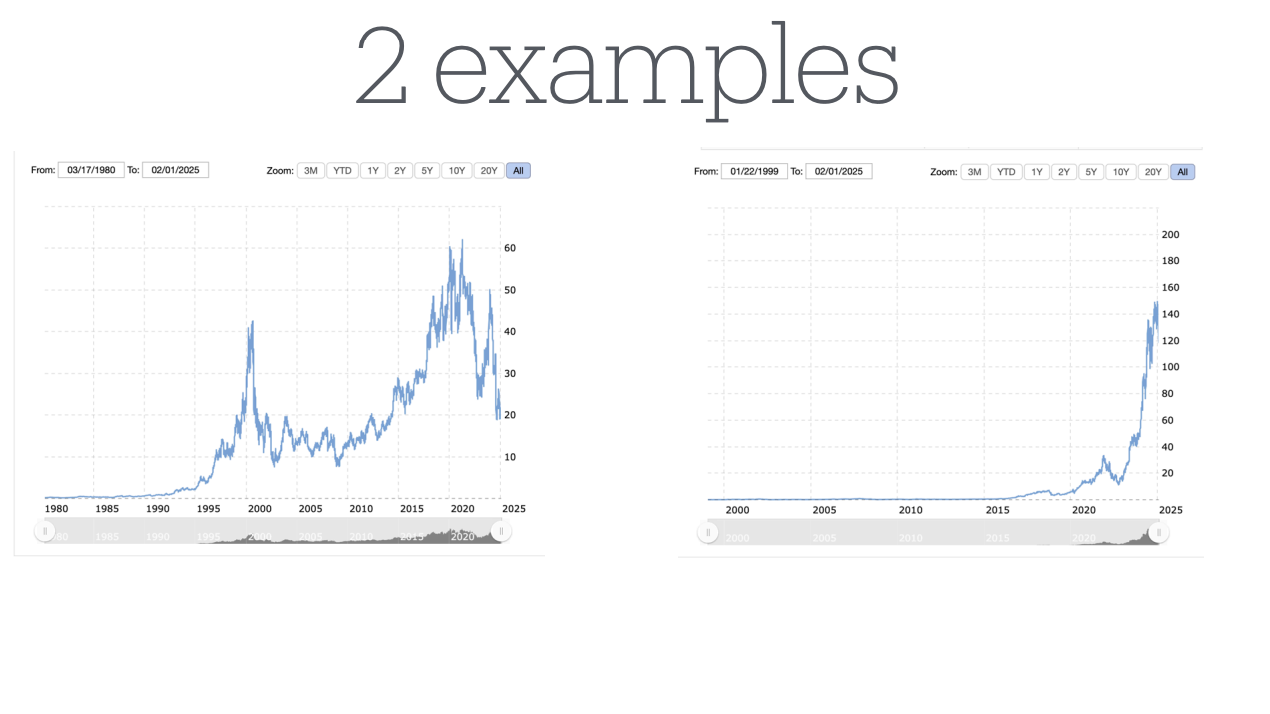
And I’ve got two nice graphs from the IT industry here. I’ve actually chosen two chip companies, but they’re actually, I found lots of examples, but I thought these were quite fun. So this is a chip company that’s reinvented itself, I think, three times, and it’s been an up. It’s been a down, it’s been an up. Any guesses? Intel, yes. Whether it goes up or whether it goes down again will be interesting. As I said, I’m a historian. I study the reach of history.
You probably guess who the other one is. This one’s bundled along the bottom – NVIDIA, yeah.Sometimes you do get rapid growth, sometimes it’s an up and down roller coaster, but very rarely is it’s perfect product market fit. Even if you hit product market fit, the market always changing. The Chinese are going to release a new version of an AI, so it’s a constant adaptation.
Historical Analogy: Adapt or Die
So, for the last couple of years, we’ve been silver sponsors at an event in Istanbul run by Google called DevFest. Obviously, there’s a historical interest there. And we go out with all the developers, and we go for the speakers tour after we’ve done the talks, and they say, Mark, why have you got a degree in medieval history? And what use is it in a software company? And I say, Well, there’s two reasons. First of all, when we go to this building, anyone to tell me what that building is? Church of the Holy Wisdom, or Sophia? Yes, when I wasn’t eating fudge, donuts or running, this is what I was studying.
First of all, they let me do the speaker’s tour because I know more about this building than anyone else, or almost anyone else. I will pretend I do. And the other thing is, I’ve studied history, so I’ve got a definition of what’s quite a complex historical theory here. But essentially, the Roman Empire collapsed because its ability to adapt and change was no longer able to keep up with change. And it’s not just civilizations, but it’s also companies and businesses and countries that have this. We reach a point where in a constantly adapting world, we cannot adapt fast enough, and that’s where things collapse. So that’s why the Roman Empire fell. That will be on the test. So make sure you got the answer to that question.
I think maybe we’ve arrived already. We got sent this last week. Again, like everybody, we say to these people, we have an enterprise tier. So I hate this form, but they’re paying us $19,000 to be on the Enterprise tier to answer this question. So I think that’s a fair trade. Again, I don’t even know what half of these things are. If you’re into the big enterprise space, this is a game you have to play. That’s not our target market. So we try and stay out of that.
Again, I think we obsess more about Moore’s law, with things constantly scaling to infinity. Amdahls Law is less known. So Amdahls Law is the law that says, if you have nine women, you do not get a baby in one month. There are certain things that just do not scale. So for the technical geeks there, if you have a problem that can be split into four parallel processes, then you cannot speed it up by more than four times, because no amount of extra processes will make any difference. So by all means, remember Moore’s law, but stick to Amdahls Law as well.
Why Companies Grow: Good and Bad Reasons
So there are several reasons businesses grow, and I’m going to be opinionated and have good and bad opinions on them. The first one is, sometimes we do genuinely have a big problem that needs a big solution. As Roy Schneider found out in the film Jaws. Sometimes you do just need a bigger boat. So you do need resources to solve this problem. That’s fine. Sometimes your product, just as Nvidia said, suddenly you are in the right place at the right time, and you should absolutely grab this. I thought this was an intriguing photo. There’s a AI image generating on the map called Image playground, and I said cats and selling like hot cakes. And this is the image it came up with, which is quite fun and cute. But more often, the reason people grow companies is inflation. There’s this just general trend that things get bigger over time, and we hire people and we keep them busy. And base camp has a strong opinion on this, because if you hire managers, they look for things to manage, whether there is anything to manage or not, and you get a lot of busy work going on companies which is expensive and doesn’t actually contribute to the mission. Sometimes it slows down the mission, because then we have to hire more managers to manage the managers, and they find things to do.
Investor pressure, and I get that. If I’ve bought into a company at 1 million US dollars, I want the company to be sold, and I get 10 million US dollars. That’s how VC works. But what my gripe with that is is sometimes you are over scaling businesses that would be successful in certain market, but you’re trying to make them big. Not every company is going to be Facebook. There’s plenty of space for lots of small companies, particularly in a niche.
Churn and burn. You’ve created your own little Ponzi scheme. You can’t hang on to your customers, so you need to build an organization to keep finding new customers. And ego. I have to be the richest person in the cemetery. I can’t just be the second richest person in the cemetery. You know, so long as Elon’s got more money than I have. That’s what keeps me up at night, even if I have plenty to spend. And lastly, boredom, something you need to be careful of with the CEO has lots of free time. So they’ve gone out and said, Oh, if we just buy this company and bolt it onto this product, suddenly we’ll achieve this miraculous synergy, which very, very rarely works.

So there’s some BoS talks you need to watch on this to get your opinion. And again, I’m not telling you what to think. I’m hopefully questioning your thought and encouraging that. So first of all, Scott from Atlassian does a brilliant talk, and he turns every problem of an adversity into a strength. Entrepreneurs are people who take their weaknesses, and they make strengths out of them. So my TLDR is, just watch it.
Slightly counter intuitive again, is Natalie found that building a business. Again, you build a business, you hire people, and you have this beast. Anyone heard of the beast? So a company will get this sort of momentum, and everyone’s busy, and we need to hire more people, and they find more work to do. And what Natalie said is, one day, she woke up and said, I’ve built my own hell for myself. If you want that kind of job, why don’t you just go and work for a large corporate company, and at least you don’t have the responsibility of all these people to hire? And I’ve met lots of entrepreneurs with that feeling, so it’s how she scaled back and made a company where she was in charge, not the company was in charge of her. Sometimes you can be too big to succeed.
And again, I love this quote from Seth Godin, a small business is not a big business. It’s completely different. One of my wife’s university friends is the CEO of a Northern Water Company, I won’t tell you which. And we went up to see her last weekend, and we were chatting about this, and it turns out that the levers that she has and the levers that I have and the things that keep her awake at night are very different from the things that keep me awake at night. So it’s a very, very different experience. We’ve been really lucky to see some of these companies, they’ve come and they’ve candidly shared their talks. What I love about business and software is, first of all, you find lots of really interesting tools to use. So we’ve used base camp ever since Jason Fried demoed it. I mean, how does the guy even know it worked? Most CEOs don’t even know what their company does.
Balsamiq, again, Peldi has been really generous on sharing his talk and admitting where he’s changed his view when the facts have changed. We were one of the first HubSpot customers, because we went to Boston in 2008 we adopted it when they were a small, plucky company. We stopped using HubSpot in 2015, when they were just hyper scaling the company and we felt the support department, the service had gone downhill.
So one of the really interesting things on coming is, not only do you use the tools, but you also get to hear the CEO, and then you get to compare the CEO’s vision to what it’s actually like using the product. Bridget Harris, so we’ll be having a quiet word with you later. We’ve also seen MailChimp. That’s the big imposter syndrome for me sitting here is there’s probably some guy sitting in the back who’s just quietly taking notes and going to sell his company for a billion dollars next week. And he’s turned up, and he’s listening to me doing the talk, I should be listening to him.
Youcanbookme, again we saw Bridget demonstrate it. We really, we really keen on using that, and I really looking forward to a talk later to find out about it. BoS, now that’s an interesting company hiding in plain sight, pretending not to be a company. That’s been an interesting journey. And Derek Silvers with CD Baby, I’m going to talk about him later.
So if you take nothing else of my talk, please ask yourself, is size your competitive advantage? If it is, be very careful about changing it.
So what we’ve learned is, first of all, as I say, it’s a trade off. You should always be making your company bigger or smaller. If you came to my breakout session last time, I was asking people in the audience, what size should your company be? For us, though, smaller is agile. We keep it small. We keep our costs down. It allows us to do more stuff, and also, inevitably, the bigger the company, the more systems you have to build. That’s a natural consequence of having a bigger company, and you cannot run a company without it. But the consequences of it are that you have essentially systems in place, and you find it gets much harder to do things. We find less is a great way to approach problems.
Again, with Shape Up, we were talking about trying to get the least you want to do. Anything that’s an open ended thing is never going to work. And lastly, we feel very much we’re more edgy coffee shop, rather than large corporate Starbucks. That’s where our strength is. That’s what we do. That’s what our customers like from us.
In order to execute this dream, I have to hire some people, and I have to make them stay enough to get the best out of them. I’m not sure how Jason Fried is going to be feeling about being paired with godfather. Here, I might ask Ryan after a couple of beers and see what his thoughts are. Again, most companies hire too early, and then either they have people sitting around they need to find work for or they have to fire them. That’s been the big trend since post covid.
I love this quote, “It’s not personal. It’s strictly business.” Because this is the one when you get to Weasley middle manager who’s going to throw somebody under a bus, this is the one he always quotes to them. To me, business is very personal, because it’s about people. That’s the hard bit. What they mean is that you shouldn’t take it personally, that just you unfortunately were the wrong person in the wrong place at the wrong time. But business is very personal, and I think we missed that at our errors. So the joke is on us, because we’re running tech companies, we thought we didn’t have to deal with people. We can’t sit on our desert island and enjoy ourselves. So, the challenge is to find the right people and also retain them and bring out the best in them.
Hiring and Culture

There are some talks you need to watch again. Bridget Harris, she can’t decide whether I like her or not. I’m sort of playing playing hot and cold with Bridget, which is, I’ll let her know afterwards. She wrote the definitive talk on hiring. What is particularly good about this talk is she covers two case scenarios. One, if you want to hire, say, an SEO expert and you don’t actually know what SEO is, she tells you how to figure out the right person to hire. And similarly, if you want to hire an SEO expert, and they’re probably the second best person on the planet, because obviously you’re the first one, but you need to delegate it, she covers that as well. So I’m not even going to attempt a hiring talk, because the definitive hiring talk has already been done. Go away and watch it.
Catherine Thompson and Bob Moesta. Again, as you know from the talk this morning, we’ve used that since 2022, it’s a really good talk. And lastly, Joel, book smart and gets things done. In my opinion, a small special team of really good people working together will beat a large team any day and at a much lower cost.
So the BoS tilts you need to watch in terms of culture. David Russo, I quite like this one. He reminded us there’s two aims – to be profitable and to stay in business. Those are your two ultimate aims. Whatever else you choose to do is up to you. He also went through the five different types of cultures. So there are cooperative cultures, there are competitive cultures, there are entrepreneurial cultures, there are explorer cultures. I’m not going to run the Morph loft because he does it better than me. The third key takeaway that David had on his talk, and the reason that most people haven’t watched it is a key thing to remember, is never follow Seth Godin at a conference. He’s a bit like the babysitter who takes your kids, you give them lots of sugar, gets them hyper excited, and then shoves them back on you.
So yeah, first question, if Mark asks you to talk at Business of Software, is, Who am I following? Peldi again, did a brilliant talk on how you need to change your company. And again, this is a natural thing about growth. You make a bigger company, you need to run it differently. That’s the normal order of things. The question is whether the benefits outweigh the costs. He also reminded us that we’re not responsible for making people too happy. And lastly, if you’re a CEO, sometimes you need to be looking out the window. If you’re always working in the business, then you are in trouble.
So every company, in my opinion, is a lifestyle company. If you sign up to work for Tesla, sign up to work for Elon at X, agree to work 90 hours, that is definitely a lifestyle decision. So think about that carefully. In terms of culture, you do need to write it down so people could point and say, This is what we do, this is what we don’t do. It needs to actually be true. And I love this word. Noppadon introduced me to platitudes. What is a platitude? I hear you say. So we always hire the best people that is a platitude. Does anyone have this on their website? Yeah, maybe that’s what we’ve been missing all these years. Crap. People are so much easier to hire, they’re so much easier to fire in place, and to be honest, the customers just don’t notice the difference. So what do we do? Well, our horror and culture, I think it’s probably best to ask these guys.
Chika Emebo
As you guys are aware, Mark was once a teacher, so it’s only right that during the hiring and interview process, he gives everybody homework. So at your interview process, during your interview process, everybody is given homework so they understand the difference between a small company and a large company. They need to know what they’re signing up for before they’re in the system and trapped.
Nadir Shah
Yeah, and it’s important to tell them that they are not working for a large company, whereas when you’d be working for a large company, you’re a unit in a machinery. But when you’re in a small company, you’re actually an important component that could bring the whole thing down. And also the fact that larger companies tend to have silos, whereas smaller companies, specifically, our company is where you have communication across the board. So something that they’ll be involved in would be like business processes, and their opinions will be heard and they will make an impact. So nowadays, we don’t have naive 23 year olds. For example, Chika, she has her own business. So she has her own startup as well. What we do is we hire placement students, and we tend to see that placement students tend to grow more, and we hire them on a one year placement or either a one year contract like Bob mentioned as well.
Chika Emebo
So IDR solutions, we do one year interviews, and these work both ways. It’s a year for the placement student to test out if they’re a good fit at the company, and also for IDR solutions to test out if they’re a good fit in the company and within the culture. And as Bob mentioned earlier, at the end of the one year period, you would hope that they want to rehire you as well. So it does work both ways.
Nadir Shah
And it’s interesting because other than Mark, because he’s the founder, all of our employees were placement students who decided to stay. And what we tend to do is we give them responsibility and start unloading responsibility slowly within the year, so they feel like they’re more part of the process. And that builds a sense of equity in them as well, and also the fact that they tend to be more present when those kinds of decisions, strategic decisions are being made.
Chika Emebo
Unfortunately for placement students, IDR solutions is not the type of company where you’ll be making coffee for people and handling documents. We have products for that already. It’s very hands on, and everybody has an impact and makes a difference.
Nadir Shah
Yes, and the small company is always incubator for bigger ideas. So we hire smart people, because they tell us what to do. And a lot of these people that we hire also come up with these new ideas, and we always test them out in the market. Of course, you have a process for that, but it’s always refreshing to see new people come in with these ideas.
Chika Emebo
Due to our company culture, we have extremely low churn rates. Everybody, apart from one person who’s in the room right now, has been in the company and came in through the placement scheme. So it really does help our retention.
Nadir Shah
Yeah, and also the fact that this whole system of hiring placement students has enabled us to create a system, and with that system, this year, we were able to determine that we did not want to hire anyone. But that decision was clear to us, because all of the people that we did hire previously had become part of the system and were part of that decision making process.
Mark Stephens
So again, Jason said, Your aim is always to give yourself good future options. You don’t know what the future is, but you can try and ascend. You sent a gift to yourself, of some good choices to make. And Scott Shafer, who’s one of the other guys in the roadside MBA says “No best path to business success, only your path.” So we focus on being bigger, as we said, better not bigger.
So Jason wrote a brilliant talk called your company should be your best product. In which he explains how base camp is what they work on, they regard it as a product in its own right. It’s continually iterated and improved, and that results in the products that base camp improves also getting better and also a very low churn rate. Again, his key point was, protect your employees time and attention.
Bob Moesta as well, wrote one on Jobs to be Done, which he told us about this morning. So I don’t need to sell that to you. They’re both brilliant, and they give you the tools. Our focus, as I said, is on bigger, not better. And there are four books that I’d like to recommend to you if you’re interested in this, better, not bigger. Freudian slip. Just checking who was paying attention.
Better, Not Bigger
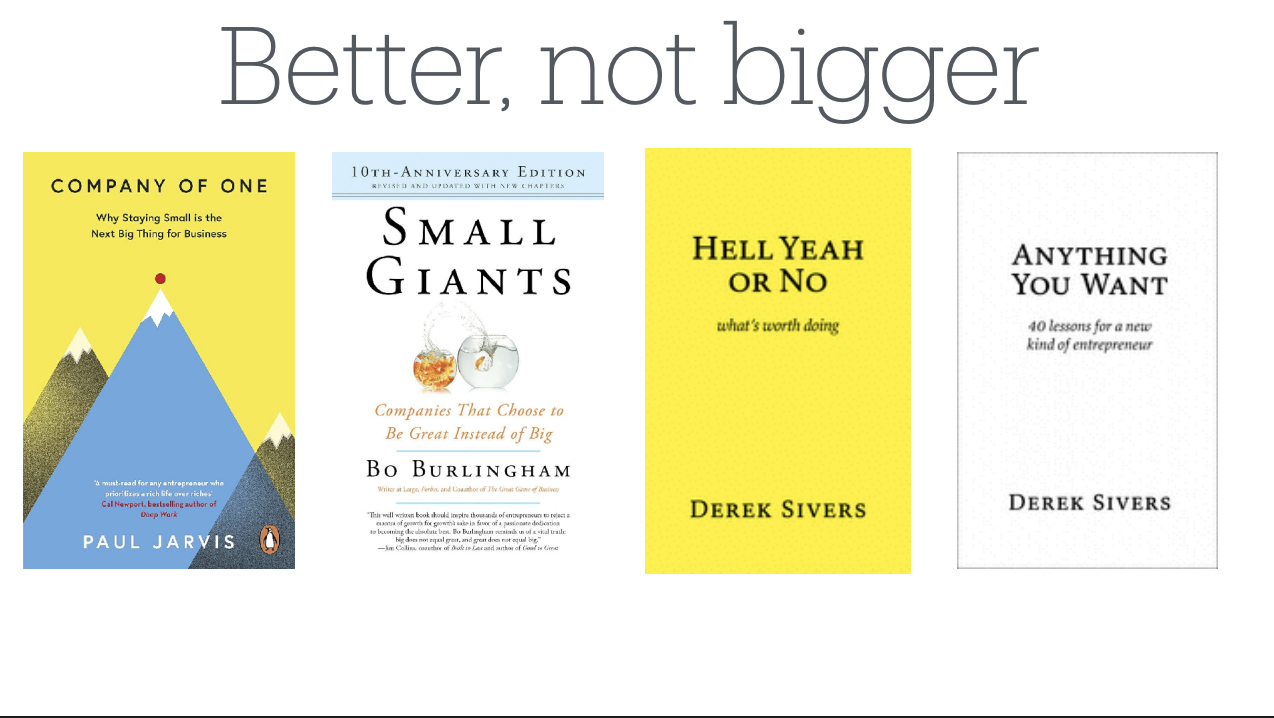
First of all, there’s a really good book called Company of One mentioned a lot of people you will have heard of at base camp, at Business of Software, including base camp and other companies, focus on how we can be better, not just grow our numbers.
Small Giants used to be a book. It’s actually now an organization. If you jump on LinkedIn, they’ve got a conference coming up in a month. So you want to focus on quality, not quantity. Check them out.
We have had Derek Sivers after he set up CD Baby, he created he’s been writing books and thinking deeply. And two books we love are Hell Yeah or No. That’s always our go to decision. So if we have a hiring decision, it’s always hell yeah or no.
And lastly, anything you want, you can have anything, but you can’t have everything. I spoke to emailed Derek, who lives in New Zealand, and said, Would you consider doing an offer for the BoS crowd? Say maybe 2% of one of your books with the BoS code? And he came back and said, Actually, I love BoS. So this is a genuine offer from Derek. He’s one of these guys who’s super rich, super smart, super nice, super successful, super handsome. You know, my opinion he should be shot as a bad example, but essentially he is offering. So he’s saying, if you’d like to email him, he will give you a free book. So you’ll be given a free introduction to the most generous, kindest, smart, generally smartest person in the room. If you turn that down, then I have no sympathy for you. So I’ve been we’ve included that link at the end, but he’s offering you a genuine, free book. It’s probably a smart move on his part, because when you’ve read one, you’ll want to read the other four. But definitely check him out and at least chat to him. He’s very chatty. He will answer your emails. Super nice, super smart guy. So say the only reason he’s not here is he lives in New Zealand, and Mark wasn’t prepared to fly in business class from New Zealand. Again, the roadside MBA, I mentioned it. It’s an old book, but it’s brilliant, so please check it out and read it.
Our view is always you have to evolve or die. So just because we don’t want to get bigger, we do need to get better all the time. And there’s some nice, scary stats for you. So 10% of UK companies are older than 20 years. And what’s most frightening is the average age of companies is going down. So it’s dropped from nearly 11 years to nine years. So the life cycle of company is getting smaller. So our perspective is, again, this is a quote I gave my first employee in 1990. We developed cutting edge software for our clients in an environment where people want to stay and grow, and I’ve had employees since 2006 so I think I’ve done reasonably well on there.
So it feels like I’ve run 25 companies, not one. It’s been a constant Snakes and Ladders. We’ve always used small to our advantage, and we’ll continue to do that. We want to grow our team in their abilities, not in their numbers. And that’s what makes people stay is they have the opportunity to create roles for themselves. Some people need a ladder, and that’s fine. I get that. We’re not for them, but for people who want to create their own little niche, that’s what a company like ours is for, and I want to continue it to the next generation.
So I’m 56 now. I don’t want to be coming up here, Mark will let me come on my Zimmer frame in 25 years, and I’m 81. I don’t plan to be doing that. So a lot of my time, one of the reasons I did this talk was to think about how we can take it forward, how we can move it forward. And again, that’s a question for me. So how do I do it? So maybe I should ask them. And what’s really interesting is I haven’t heard this bit either, so this will be as big a surprise to me as it is to you guys, so watch my face. So what should we do, guys?
Chika Emebo
So it’s only right that we plan to put Mark on the bench.
Nadir Shah
Yeah, and it’s not as bad as it sounds, but what we plan to do is, in the next 10 years, we plan to give Mark of a coaching role, and have a strategic overview of where the company is going. He will be there in the processes and everything, but he wouldn’t have to actually be involved in them. He’d be there a lot less.
Chika Emebo
So we do appreciate your hard work, but soon enough, you’ll be able to sit down kick back on your cruise and we can take over.
Nadir Shah
Yes, and with the new talent that comes in every year, they bring in new ideas as well. They get enrolled onto the program with Matt and Noppadon and they get their chance to speak at BoS. They get the chance to speak at DevFest. So that creates a pipeline for success.
Chika Emebo
As a small company, there’s a lot of autonomy within each individual, and we’re able to take action and make real impact. So we aim to continue this and continue to grow at a slow pace.
Nadir Shah
Yes, we aim to be smaller and bolder and do more bolder experiments. For example, we had recently hired a Chinese speaker, Xin Yu. She came to BoS in 2023, and why we did that? We wanted to tap into the Chinese market, get some of that deep seek money.
Chika Emebo
IDR solutions, the power of relationships is everything. Our company culture being small, we do have a good, strong relationships with each other, and we also have the same with our customers and our dear friends, such as Mark at BoS.
Nadir Shah
Yes, and we truly believe that with all the new technologies coming in. Moving forward, smaller companies will have an edge where they actually establish these relationships with their clients, and that’s the one thing that will make the small companies stand out.
Chika Emebo
We are confident in our identity so we do not jump on hype trains and get stuck on a journey heading God knows where. However, we are able to identify when we need to be aware of new trends such as AI. Hence why we went to the Salesforce conference last month.
Nadir Shah
Yeah, and we like to hop on the hype train as long as you can get off on the next stop, which is what we plan to do when we vendor Salesforce. So we are looking to implement more agent force AI into our sales data and our customer data, and find identify trends. Science in that aspect as well. So being very careful with the way we use it, I think Mark would call it healthy skepticism.
Chika Emebo
So just to be clear, we won’t convert into any sort of AI company anytime soon.
Nadir Shah
So you can watch all the videos on the next slide, this should be a QR code.
Chika Emebo
Thank you for your time today. Thank you for listening.
Mark Stephens
And that that was Nadir’s first talk, and Chika’s first proper talk. So I think they deserve a round of applause.
So we have, as long as Mark wants to give us for Q&A. Or if you’re not going to ask some, we nicked an idea from Derek.
Mark Littlewood
I don’t know how old Nadir is. But I do know that, I hope you don’t mind me saying this Chika, that you’re 23 and while you’re technically employed, you’re also full time.
Chika Emebo
I’m still an undergrad student, at the moment.
Want more of these insightful talks?
At BoS we run events and publish highly-valued content for anyone building, running, or scaling a SaaS or software business.
Sign up for a weekly dose of latest actionable and useful content.
Unsubscribe any time. We will never sell your email address. It is yours.
Q&A
Mark Littlewood
And will be doing your finals in a couple of months. So good luck. Nothing but respect. No, we’re gonna do Q&A. I think much better.
Mark Stephens
Okay, so we had it as Q and I, so they could ask us questions and suggest ideas. And if they weren’t going to ask us questions, we were going to, like, take them apart.
Audience Member
It was mentioned that Chika has got a side business. What is it? Can we have the elevator pitch?
Chika Emebo
So it’s a wellness business. So I host wellness events such as Pilates classes and tennis classes to bring women into wellness together, and I also sell merch, essentially. So it’s athleisure, so wellness activities, plus athleisure bringing women together that enjoy it, because I enjoy it in my free time, and I didn’t have anyone around me or any friends that enjoyed that either. So I decided to build my own community, so I didn’t have to change my friends, but I could attract new people that just like that stuff to. Yes, angeldupe.com
Mark Stephens
We’ll add the link to the BoS slide after the talk.
Audience Member
Hi, I’m interesting about your hiring process. Do you do largely remote hires, or do you hire from the local area? Because your process is really interesting and it is innovative, so I wonder how hires react when they first encounter that process.
Chika Emebo
So our hiring process is we hire placement students from, predominantly from two different universities, so either from Kent or from Leicester, and they go through the universities to apply, and then we do interviews with them, and if they get the job, then they start straight from there. They do the year long interview, which is their placement year, which is basically an internship for you. Unfortunately, for Mark, it’s not free. He pays them. So yeah, they go through that process, and if they’re a good fit, then potentially they get an invite to stay full time afterwards.
Mark Stephens
Yeah, we keep them. So we say, in the first year, you need to be in the office three days a week, because we want to train them up. But the other thing is, if we work together for a year, three days a week, then we have a good working relationship, and that opens up doors. So if you decide you need to work in Cornwall because you want to spend your weekend surfing, that’s an option. Some of them want to be in the office, some of them don’t. But we’re quite strict that the first year is in our office in Kent, but there are thereafter. As I say, once we’ve got this good working relationship the world. You know, the options are there?
Mark Littlewood
Thank you. Maybe there was one, was it Mark?
Audience Member
So the question is, how many employees do you have?
Nadir Shah
At the moment, we have 13 employees. Yeah, so we did hire Xin Yu, like I mentioned. But this year we couldn’t find the right candidate, but there was no pushback on the decision to actually not hire someone, because I believe that that was a decision that we made as a whole.
Audience Member
Follow up question, the employees shareholders in the company?
Mark Stephens
The employees are not shareholders in the company. My experiences of owning shares in non tradable companies was influenced by News International. Essentially using that as a way to pay cheap people cheaply, whether they paid me in cash. So I think if you want to incentivize people in that, there are other ways to do it, like giving them golden parachutes or whatever. So what we do is we have non tradable shares in a company that you might not be a member of for a long time. It’s not a great asset. So long as I own 51% of company, I can decide what to do. So what we do is we do have a bonus scheme. So 20% of the profits the company generates goes into a bonus pool, and these guys share it. And there’s a slight trend towards people who’ve been at the company longer get slightly more. But it’s designed to be fairly equitable. Our view is, either everyone wins or no one wins.
Mark Stephens
Founder, IDRSolutions
Mark is the founder of IDRsolutions (which develops software to do lots of cool stuff with PDF files).
In 2009, Mark Stephens did a Lightning Talk at BoS, “Asteroid Impact – Are you a large lizard or small and furry” which looked at the challenges of running a software company.
He is a self-described passionate Mediaeval Historian, St. Andrews graduate and owner of a very dry sense of humour.

Chika Emebo
Sales and Marketing, IDRSolutions
Chika Emebo is a sales and marketing expert at IDR Solutions, where she uses the Jobs-to-be-Done (JTBD) framework to understand what truly drives customer decisions. By refining ideal customer profiles and creating targeted strategies, she helps businesses build stronger relationships and achieve meaningful engagement.
Chika is also the founder of ANGELDUPE, a premium wellness brand. She applies the JTBD framework to identify her audience’s needs and aspirations, using those insights to craft content and products that encourage healthier, more confident lifestyles. Her approach is rooted in her passion for personal growth and her commitment to creating impactful solutions.
As a speaker, Chika shares her experiences with JTBD, sales, marketing, and entrepreneurship at conferences and events. She enjoys breaking down complex ideas into actionable strategies, inspiring others to reach their full potential.

Nadir Shah
Marketing Specialist, IDRSolutions
Nadir Shah is the marketing specialist at IDR Solutions. He excels in creating ICP-centric messaging and optimizing existing channels while looking for new opportunities. He applies the Jobs-to-be-Done (JTBD) framework to understand customer journeys and use insights to uncover a highly niche SaaS market (businesses looking to integrate PDF solutions into their applications)
Nadir focuses on growth, positioning, and customer understanding, ensuring that marketing efforts align with what truly matters to users. He enjoys exploring innovative ways to bridge the gap between technical products and real-world applications.
