A candid talk for founders who’ve seen growth stall and want to know what it actually takes to come back.
Following 9 straight years of growth, Buffer experienced the largest decline in the company’s history. In this candid talk, Buffer’s Founder and CEO, Joel Gascoigne, shares the story of Buffer’s multi-year decline, where Buffer’s ARR dropped 20% over 4 years to $17.1M. Even in this nerve-wracking situation, Joel persisted in leading Buffer to new all-time highs, and Buffer’s ARR now sits at $22.3M. A story 5 years in the making, Joel will share his journey navigating Buffer’s decline and the monumental effort it took to turn it around.
In this talk, Joel will cover:
- Missteps and early warning signs of an emerging plateau
- What it feels like to be in free fall
- Going inward to rediscover purpose and seek a new path
- Steering in a new direction during a decline
- Strengthening culture in the midst of a turnaround
- Achieving all-time-highs our own way
- Embracing differentiation to thrive long-term
Slides
Find out more about BoS
Get details about our next conference, subscribe to our newsletter, and watch more of the great BoS Talks you hear so much about.
Transcript
Hi everyone. My name is Joel. I’m the founder and CEO of Buffer, and I’m excited to be here. The last time I was at BoS was 11 years ago. I spoke when I was a baby in my journey at Buffer, and the timing is perfect for me to come back, because I have a story to tell.
This is Buffer’s ARR over roughly a 15-year lifetime. We had 10 years of that up-and-to-the-right growth you want to see in your startup, a great ride. Then right around 2020 we hit a plateau at around $22 million in ARR, and went on to decline for three to four years, down a total of 20%. As you can imagine, this was a scary time.
I’ve spent some time since then reflecting on what happened, and I’m excited to share this journey: what were the decisions that led to the plateau and decline, what did we do to get back to growth, and how it felt along the way.
A bit more about me: I’m originally from Sheffield in the UK, living now in Boulder, Colorado with my wife and our two young kids, four and a half and one and a half years old. When I get free time (we have a four-day work week, so there’s a little), I love to ski, mountain bike, or try to catch some surf. Buffer started in late 2010. I built it to solve my own problem, spacing out content I was sharing to Twitter. Today Buffer has around 67,000 paying customers, $22.7 million in ARR, and in 2025 we’re on track for around $2.5 million in net income. We’re growing 22% year over year, our best results in probably seven years.
We’ve also had an unusual fundraising journey. We raised a total of $4 million over two rounds, but our last round was in 2014, over a decade ago. Since 2017 we’ve spent $10 million buying out investors and alumni to put ourselves firmly on a long-term independent path.
The Growth Years (2010-2019): Seeds of What Came Later
I’ll move quickly through these years because the growth was great, but the details matter for what comes later.
In 2010 I started Buffer, found the first few paying customers, and ended the year with a grand total of $20 in ARR from four customers. I was excited. It was the first dollar I’d ever made online. In 2011 my co-founder Leo joined, we went through an accelerator, raised $450,000, and ended the year as a team of three with $200,000 in ARR.
By 2012 and 2013 things were ramping fast. We added LinkedIn and Facebook to our Twitter roots, built a powerful browser extension, and stayed closely connected with our community. We also made some important cultural decisions that have defined us. We became a fully distributed team at a time when you could count remote companies on two hands. When we were just 10 people we established our core values. One of them, “default to transparency,” led to us rolling out salary transparency in 2013, both internally and externally. You can still go to buffer.com/salaries today and see everyone’s salary, including mine, and the formula we use to set them.
By end of 2013 we were a team of 16 with $2.3 million in ARR.
2014: The Pivotal Year
We received our largest acquisition offer. It felt like what Chris was describing yesterday: crazy to turn down. Beyond life-changing money for myself and the whole team. But at the time we were this remote company I was running while traveling the world, following values and building something that felt genuinely unusual and special, with strong growth. I remember our advisor Heaton Shaw asking: “You want to keep doing your crazy shit, right?” And we said yes. So we turned it down.
Some advisors then recommended we raise a little to take some off the table. So we raised a $3.5 million round at a $60 million valuation, gave up around 6% of the company, and crucially, maintained full control. No board seat. Unusual for a second round of funding.
2015-2016: Getting Carried Away
On the back of the raise we felt like: let’s make this big. We doubled the team size from 2014 to 2015, investing ahead of our growth. Revenues didn’t quite double to match. Then in 2016 and 2017 we hit turbulence that planted seeds for what came later.
We hadn’t built up financial discipline. No finance function. Team growth outpacing revenue. We got to a point where we had $1.3 million in the bank and were four or five months from zero. I had to say goodbye to 10 people. A devastating moment for such a tight-knit culture, one that took a long time to rebuild from.
Then in the midst of that, my co-founder and I started having different views on direction. Leo wanted to stay on the hyper-growth path: change whatever needed changing in the product, the customers, bring in executives. I wanted to protect and cultivate the culture we had. Leo moved on at the beginning of 2017.
Six months after the layoffs, with my co-founder and our CTO both gone, I decided to stabilise. Hiring freeze. Focus on rebuilding trust with the existing team. And then, once things had settled, severe burnout. I couldn’t get out of bed. I took six weeks out, did nothing at first, then started exercising, then recovered. One of my fondest memories from that time: going to the Dominican Republic and learning to kitesurf.
It was a good job I’d recovered, because shortly after came one of the hardest things I’ve been through at Buffer. Leo, having put six years in and seeing $13 million in ARR, understandably wanted some return. We’d just been through layoffs and were rebuilding cash reserves. I wasn’t in a position to buy out his shares. So he started selling shares on the secondary market. Different investors, different expectations. My chosen path for the company was long-term independence. His secondary sales were creating a cap table that I’d eventually have to find returns for at valuations I didn’t see arriving for many years.
Things got tense. One day I woke up and he had emailed all the investors. I found out because one of them forwarded the email to me. He basically said the path I had in mind would tank their investment and that I didn’t have the experience or team to execute. I had to do a lot of damage control, respond to those emails, talk with a bunch of investors. The VCs from the 2014 round were already inclined toward the hyper-growth path. It was a real struggle.
Eventually a friendly non-traditional investor purchased a chunk of Leo’s shares, giving him some liquidity that eased things, and then he resigned from the board. That was the moment I gained clarity: I need to buy out these VCs. The alignment wasn’t there.
The 2016-2017 results reflect the journey. We made a loss in 2016, then rebounded in 2017. The hiring freeze, combined with continued growth, turned our bank balance from $2 million to $5.5 million, setting up the possibility of a buyback.
The Plateau and the Decisions That Caused It
Coming out of those years of layoffs, departures, and conflict, we felt very defensive. A fairly negative mindset. And we had 80,000 paying customers. We were starting to feel like we had too many different types of customers, too small to handle all their different needs.
The advice at the time, and still today, is: ICP, ICP, ICP. So we decided to focus on direct-to-consumer brands, the new e-commerce brands doing interesting things with social media. They depended on social media. Great customers for us.
Our stated goal became growing average revenue per user. At that point our ARPU was around $18 a month across 80,000 customers. We could see that public companies had far fewer customers and far higher ARPUs. So we said: we’re comfortable if paying customer growth stagnates, as long as ARPU grows.
We made a series of changes. We reduced the free plan and removed features. Customers weren’t happy, but we pushed through. We increased the Pro plan from $10 to $15 a month and also reduced the functionality on that plan. About a year later we removed the free plan from the pricing table, put it underneath with a small button. Then eventually we removed sign-ups to the free plan entirely. If you wanted it, you had to go through a trial first and drop down.
We also embarked on a multi-product strategy. Another common playbook: as you hit a certain scale and plateau, layer in new products with their own pricing, enable upsells and cross-sells. We made an acquisition, started building out multiple products, eventually got them working together with their own tabs and navigation. It took a lot of architectural work to get there.
Meanwhile, as a leader, I was struggling with the transition from having a co-founder to being a solo founder. I’d been reliant on Leo for things he was great at. I became hands-off and passive with the leaders I was working with, not making the decisions I should have been making. Our strategy became a Frankenstein: VP of Marketing says this, VP of Engineering says that, paste it together. Not coherent.
This was around when I started working with my executive coach, Jim, still working with him today, five years later. That’s been a transformative journey for me.
One bright point: in mid-2018 we spent $3.3 million, half our cash, to buy out the VC investors from the 2014 round. This unlocked our ability to buy out some seed investors too. Then in mid-2019 we fully bought out my co-founder through a combination of a friendly investor purchasing 40% of his shares and us doing the remaining 60% through cash flow. This was the moment where I felt it: we are cementing our future as a long-term independent business. I’m in this for the long haul. Why put yourself through all that pain just to sell the company a year later?
The tactics were working. ARPU was growing. But this is what was happening underneath.
We’d hit our peak of 80,000 paying customers, and then they just started declining. At first we told ourselves this was the strategy working. But as it went on, I think we all started to wonder: is this sustainable? If customers keep dropping, that’s a sign something isn’t working.
Free Fall: 2020-2022
We arrived at the plateau in 2020. Pre-pandemic we’d already plateaued at around $22 million in ARR. Then the pandemic hit. We had a wide variety of customers, lots of small businesses, lots of physical businesses, and they started churning rapidly. Many had to pause or shut down entirely. Our ARR dropped by 10%, $2 million, within a few months. I have a journal entry from that time. It was a scary moment. I didn’t know how long it would last.
What gave us breathing room was that we were highly profitable going into it, with a bank balance of around $7 million.
We had a brief rebound: a steep decline, then a few months of recovery, then plateau again. Looking back, I think of it as: the pandemic hit, then we were back to where we already were, which was a plateau, and the business was in a structurally weak position.
This led to a lot of rethinking.
The first was around our customer focus. Talking to customers during the pandemic, we kept hearing: “I love Buffer, been using it for years, but I have to pause my business.” Keeping an aggressive focus on DTC brands started to not sit right with me. I started to loosen that focus and reconnect with the original reason I’d built Buffer, to serve small businesses and entrepreneurs, which is what I was myself. In the pandemic there was so much creativity from small businesses figuring out how to survive. We were profitable and well-resourced. I felt a calling: what can we do to help? We put together a COVID-19 Customer Assistance Program to support some of those customers.
Second: I’d been thinking about a four-day work week for a number of years. This felt like the right moment. We did a one-month trial in May 2020, then a six-month pilot. It just stuck. We’ve had a four-day work week for five and a half years now, and everything in the rest of this story happened with a four-day work week.
Third: the multi-product strategy. We realised it was creating complexity for customers, and it had been implemented during a time when the focus had shifted to extracting value rather than delivering it. We began consolidating the products back into a single offering.
By the end of 2020 I shared a refreshed vision and mission with the team. Our vision to this day: a world with more small businesses that do good while doing well.
But it got quite a bit worse before it got better.
We were riddled with tech debt. The kind rooted in fear: touch something here and something breaks over there. The most core parts of our product, like the composer for the main publishing experience, hadn’t been touched in years because everyone was scared. That froze our shipping pace. Combined with the strategic wavering, we ground to a halt.
Then in 2021, during the Great Resignation, we had our own. Historically we’d seen around 5% voluntary turnover. In 2021, 24 people chose to leave, around 26% turnover. Many were long-tenured. Several were leaders. We found ourselves running executive searches, ended up with two search firms running four searches simultaneously. Long processes, got excited about candidates, made multiple offers, and they turned us down. We were declining, and it was harder to sell working at Buffer when we were declining. Out of four or five roles, we brought on one executive who had real impact. It was a tough situation.
Want more of these insightful talks?
At BoS we run events and publish highly-valued content for anyone building, running, or scaling a SaaS or software business.
Sign up for a weekly dose of latest actionable and useful content.
Unsubscribe any time. We will never sell your email address. It is yours.
The Turning Point
Around January 2022 I made a decision: I’m done with the executive hiring. Not a popular decision. But I stopped, took on more direct reports, and turned inwards to the team.
Bringing in executives during a decline adds distance, adds hierarchy, between the people doing the work and myself. It was the wrong move. When I turned to the existing teams, marketing in particular, they’d been in limbo, waiting for a new leader to make decisions. I told them: we’re not doing this anymore. You are a complete team. I’m going to work with you. That empowered them to start deciding, and we started collaborating directly.
This triggered a cultural shift I started naming with the team. We’d been in maintenance mode, hired people during the growth years to keep doing what was working. But now we were in decline, and maintaining the decline means maintaining the decline. We needed to get back to build mode: build the product, build the culture, build marketing.
To drive the point home, we ran Build Week, inspired by startup-in-a-weekend events I’d done before Buffer. Cross-functional teams, one week, drop the usual process, build something genuinely valuable. It was energising. We started realising we could move much faster.
I was also doing a lot of personal work alongside this, continuing with my coach, addressing a fear of conflict that has roots in childhood, and starting to have much more honest and direct conversations. Giving people the feedback they needed to hear. Getting involved everywhere. Helping bring together a more coherent strategy. Becoming more decisive.
August 2022: our first month of growth since the decline had started. We dipped a little after that, but it was a sign that something was working.
Finding the Holy Grail
Around this time I articulated something I started calling the Holy Grail of Growth for Buffer.
MRR is simple: paying customers multiplied by average revenue per user. But there are two different SaaS growth playbooks, and they’re not the same.
The Enterprise SaaS Growth Playbook is about growing ARPU through expansion of existing customers, with prices rising over time.
The Consumer SaaS Growth Playbook gets less attention but is equally real: a free plan, one premium plan, grow by acquiring more paying customers.
For Buffer, the right playbook is primarily the consumer SaaS model. We’ve always been down market, serving small businesses, entrepreneurs, creators. So the Holy Grail for us is: grow the number of paying customers primarily, and grow ARPU gradually alongside that, but don’t push ARPU so hard you sacrifice customers to get it.
This was clarifying. And it made sense of the past. In our first phase, paying customers and ARPU were both growing, customers growing faster. When customers started declining, that was when the alarm bells should have rung. Instead, we kept pushing ARPU higher and found ourselves on an endless hamster wheel: keep raising prices, keep extracting, until eventually we’d become an enterprise SaaS product. That’s not what we started to do. That’s not what I want to do.
Around the same time I discovered the concept of carrying capacity: the number of paying customers a business can sustain, calculated by dividing new paying customers per month by the churn rate. It tells you whether you’re on a path to keep growing based on what you’re generating right now. Jason spoke yesterday about Max MRR, a very similar concept, and he kindly used Buffer’s numbers in his blog post on it. We were starting to see carrying capacity move in the right direction.
This gave us clarity: we needed to double down on freemium. Keep adding value to the free plan. Make the whole product holistically freemium, not just a token free tier. We also changed the main CTA on our homepage to take people straight to the free plan sign-up rather than the pricing page. That single change took us from around 65,000 monthly sign-ups to 85,000. Through further work in content marketing, growth marketing, and product, we’ve sustained sign-up growth from there.
Recovery and the Down-and-Wide Strategy
Beneath the still-declining ARR, something was changing. The New Buffer pricing we’d launched in August 2021, simpler, per-channel pricing, holistically freemium, was growing fast as a share of our overall business. I could see that we were going to grow again. I started planning for it.
March 2023: we hit the bottom and flattened the decline.
A lot of other things were clicking into place. We finally faced our tech debt, went into the parts of the codebase everyone had been avoiding. We found a way to address debt while building new value: any time we worked on a part of the product to ship something new, we’d refactor and pay down debt in the same area. Shipping pace increased significantly.
We also recognised a structural win-win in our pricing model. Because we charged per channel, adding more channels meant adding genuine value for customers, giving them flexibility, and creating natural revenue growth aligned with that value. Around half the channels we now support have been added since 2022.
I was also spending time on strategy: reading a lot, including Michael Porter’s “What is Strategy?” Around 30 years old, still seminal. The key insight: a strong strategy is about establishing a difference you can preserve compared to competitors. Strategy equals differentiation. If you can do multiple things across different teams that come together so the sum is greater than the parts, that’s when you have something strong. Porter also says growth is one of the biggest threats to strategy. When you’re chasing growth, you start doing things that aren’t strategically sound. Sustained growth comes from finding your differentiated positions and bolstering them, stacking new advantages on top of existing ones.
The strategy I started sharing with the team: Down and Wide.
Down: go down market. Serve small businesses, creators, entrepreneurs. An unusual direction in a world where most SaaS products chase the enterprise.
Wide: have a comprehensive product that can genuinely serve a wide variety of businesses. Previously we’d felt spread thin. Now that variety was an asset, not a liability.
Our competitors, Hootsuite and others, were going up market. We decided to go down. That put us in a genuinely differentiated position, and we decided to double down on it, not shy away from it. We started running campaigns around it. That positioning became something we kept reinforcing.
Back to Growth and Beyond
2024: 9% ARR growth. Paying customers growing again.
In 2025 we launched Streaks, a new feature on the free plan, more consumer-style, something only we could do from our positioning. It’s been a hit.
We had our 14th company retreat in Antalya earlier this year. The energy is strong. We’re well-resourced, profitable, and in control of our destiny. And we’ve been doing something that might sound unusual: we’ve started proactively cancelling subscriptions for inactive customers. If someone is paying but not using the product, that’s not right for them. We email them, say we’re going to cancel unless they tell us otherwise. You can see a dip in paying customers from that on the charts, but then we’ve grown back through it to new all-time highs in paying customers.
We’ve got a public API coming and community-building features. On the ownership side: since 2017 we’ve repurchased around 30% of shares. We paused issuing stock options for a while but are now reissuing them so the whole team has ownership again. We’ve done liquidity programs for early team members, and we’re getting into a rhythm. Even as a long-term independent company, you can issue stock, repurchase it, and create real value for the people who built it.
We’ve crossed the Rule of 40. That’s something I genuinely didn’t expect for an unfunded company at this stage.
To summarise how we got here: we went back to our roots, serving entrepreneurs, going down market to cater to them. We doubled back down on the brand, reignited growth, strengthened the culture, became builders again. And we got back to growth and profitability by re-establishing a differentiated position in the market and committing to it.
That’s the journey.
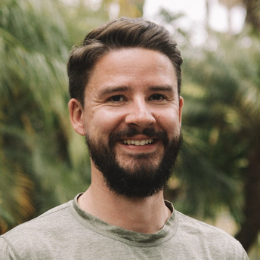
Joel Gascoigne
Joel Gascoigne is the Founder CEO of Buffer, which he founded in November 2010. Buffer is a social media toolkit serving over 70,000 creators, entrepreneurs, and small businesses. Today, Buffer is a profitable, remote-first company with a distributed team of over 70 people across 22 countries.
Joel was born and raised in Sheffield, England. He loves to travel and has spent time living in Japan, Hong Kong, Hawaii, and both coasts of the U.S. He now lives in Boulder, Colorado, with his wife and two sons. They love to ski, surf, mountain bike, and hike. Joel has spoken at BoS previously on the topic of transparency and growing a business without compromising your principles.
Next up
Online workshops
Can’t make it? More dates coming up