A key metric for current SaaS companies is Weekly Active Users. It’s also a dangerous one because the graph we use to represent it, even when it looks up and to the right, can be hiding a growth ticking bomb.
This bomb is the byproduct of how we think and how we try to improve Activation, that stage that goes from Signup to happy loyal user.
In this talk, you’ll learn a new way to think about Activation:
- What are the users trying to achieve during this period?
- What is blocking them in their journey to happy users?
- How can you solve the blockers without creating bigger problems down the funnel?
- How to measure all of that so you have an accurate depiction of your current activation.
Slides
Find out more about BoS
Get details about our next conference, subscribe to our newsletter, and watch more of the great BoS Talks you hear so much about.
Transcript
Diego de Jodar
Let’s talk about activation, the most misunderstood, neglected and critical part of the funnel. Pretty dramatic, right? But we can agree that is that part that goes between acquisition and retention. But if I ask five of you what activation is, and I did that yesterday, I got five different replies. This kind of blurry thing there, right? And it’s neglected because we focus on acquisition, we spend all the money there, all the time and effort there, and we agonize over churn, lack of retention. And that part in the middle, we just do a quick onboarding, show them the features. That’s it, right? But it’s critical. Doesn’t matter if you are B2B, B2C, PLG, sales. As we will see today, if there is no activation, there is no retention.
So today I’m going to show you how I look at activation and how to improve it. And let’s start on the end. How do we improve it? Because when we have something like this, we tend to think, Okay, how do we get more people there? How do we increase the conversion rate? And I did that. Did that for years, and kept failing at it. It’s like, it should be getting better at this eventually. It always felt like random, like something was not there. So I started looking at what was not there, and I found it. All the people that was not getting there, and I started asking a different question, that is why are they not getting there? Now you can think just a small change, well, we will see that it has massive implications.
Introducing the Mindset Funnel
So first, let’s see how far we can go asking the common question, how do I improve the next conversion rate? So we have our visits, the cost of time and effort and money, drop to sign ups. We sit down and it’s like, okay, how can we get more sign ups? Obvious, right? Let’s reduce friction. Let’s make the sign up, email. Let the sign up form be shorter. Makes sense. What else can we do? I know, let’s put a timer so if you sign up in the next 10 hours, you get an offer. Okay, sure. And then we look at our numbers, and from sign up, we see that we still have a lot of people that never use it even once. So we make our question, how can we get people to use it once? I know they need inspiration. Why don’t we send them 14 emails, one a day with some ideas, like, look, let’s make it 15. And the last day, we remind them, hey, you’re not even you’re going to miss your opportunity to see our great product.
But we look at our numbers, and almost nobody is using it a little bit. So we sit down. What do we do? Why don’t we add budgets and points and confetti? Because without confetti, there is not a proper gamification. And when all hope is lost, when you don’t know what else to do, we have it. We miss doing it. That goes something like this, Diego, we noticed that you were not coming recently, you ungrateful piece of shit. We are working here like animals delivering you insane value, and you just stop coming. Like, do you think that’s normal behavior? So that is the subtext of the team. It’s a pretty passive-aggressive or just aggressive email. That’s how far we can go asking the question, how do we improve the next step?
Why Traditional Tactics Fail
Now these tactics have two things in common. One is that all of you recognize them because everyone else is doing them, which doesn’t mean they are best practices. At most it means that they are common practices. And why do I say that? Look at them again. What do they have in common? They have the same smell – smell of pushing users down the funnel. None of these tactics solve the root cause, solve the problem, why they are stuck there.
The gamification. Look, I’m going to tell you something that never happened in your website. There is somebody stuck after using it a couple times, looking at it like, where are the values? Where’s my confetti? Like, I’m not going to keep using this thing. Like there is no proper like, what is this product? And maybe now you’re thinking, okay, Diego, I get it. What about the daily email? Like, some tips, as in 14 of them, maybe that inspired them, giving them ideas to use the product. And I will say, yeah, yeah, I agree with you. But if there is such a piece of information so critical that if I don’t know it, I will not move forward, what is doing that on an email? Like that should be in the product, not in the fourth email of a Drip campaign that goes to my spam folder. So not even that works that way.
So first tip of the day, don’t start with the question, What can we do to improve the next number? What can we do to increase the whatever ratio, whatever conversion rate? Instead, look at what is not there. Who is there? Why they are stuck? Now we can remove the blockers. And maybe then you want to do any of these things, or maybe you don’t even need them, because things just work right? So let’s see, what are these blockers, and what can we do with it?
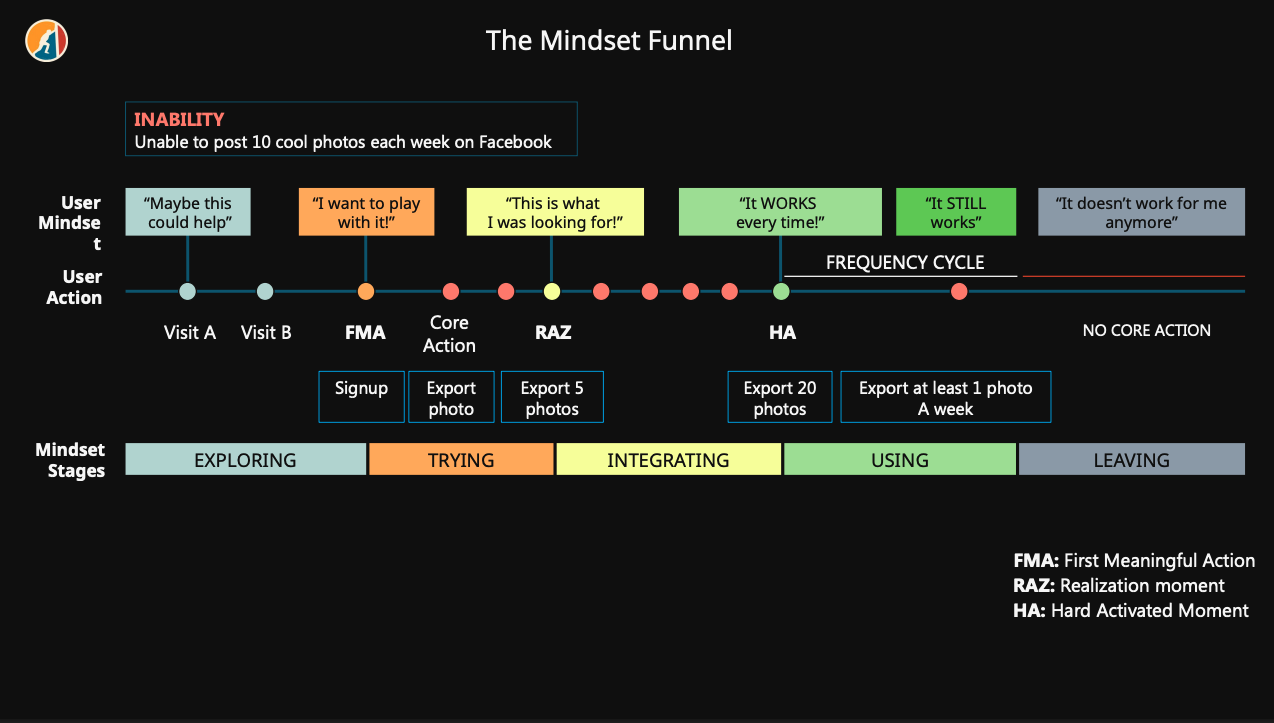
So we already discussed that to improve the funnel, we need to understand the why, and we will call that blockage. Now the interesting thing is that when the user is adopting the product, he’s going to go through different mindsets. And each mindset has kind of a different goal, and the blockers belong to each one of these different mindsets. So what we need, really to solve the situation, is a way to map these mindsets, so we can spot the brokers on each one of the drops and fix them. And I call that The Mindset Funnel.
User Story: Hailie and the Inability Moment
To explore The Mindset Funnel, we are going to look at it from the user point of view. So we have Hailie there, stock photo Hailie. That is a community manager, and she’s in a specific situation. She’s working on a small startup, and she has to do the whole thing. They don’t have resources to have a graphic designer for her. So she has to write the post, schedule the post, and edit the photos. She’s doing that with Apple photos. All good, in fact, so good that the boss one day told her, Hailie, look, I’m so proud of you. You lifted this thing, grow this channel so much that we’re going to do something. Why don’t we double down on that? And we go from one photo a day a week to two photos a day. To which Hailie said, yeah. Because now she has what I call an inability, that is not a problem. A problem is usually a hard task. An inability is when you have a hard task and your existing solution is not going to make it. She knows there is no way on earth that see using Apple photos, taking two hours to edit each photo. She can do that twice a day. There is no way. So she is forced to switch.
So let’s look at the funnel. We have the inability, the user mindset, and we need to be able to measure that in some way, so a user action. And the first mindset is, maybe this helps, that in reality is Hailie goes to Google, OK, quick editing photo tool. Sees some things like, oh, maybe this can help. Clicks there. We have a visit, screams in horror, goes back and keep checking in Google until she finds something else.
The next mindset is, I want to play with it. So when does that happen? Well, actually, when she is doing that visit, reading your landing page, and it makes sense to her, how can we measure? I want to play with it. We need also something that help us remove a lot of like noise from the funnel. So I call this a step, the first meaningful action, the first non-free event. With free I mean, there is some effort, not just money, like something that means more than just like clicking or scrolling. Because that friction is helping us know, okay, she saw something or she will not move forward. Great.
So now we have, in this case, it can be a sign up. It’s usually sign up, and the next mindset, she’s there. She has arrived. How do we know if she thinks this is what I’m looking for? First, she will try to use the product. How do we define using the product? So I do that with the core action that is, whatever thing that we can measure that help us see if she is serving her inability. We don’t know if she’s posting on Facebook, but we can know if she’s exporting the photo. So it’s like, okay, we can do export photo. And usually activation ends there. Oh yeah, she did that tutorial, exported the first photo. We are done. Giving you a clue of we are not done.
See, we’ll use it a second time. Is she using these photos? No, she’s toying around. She’s playing. She just wants to see if she can replicate in half the time the same thing that she did with Apple photos. So see, we keep doing some of these corrections until she gets to the realization moments. Rush, in this case, five photos. So we are creating there a space for her to play. She’s not an active user. She’s somebody just toying around trying to understand if this is what I’m looking for. She’s like, oh, OK, now she saw value or something. So we are done.
No, now she wants to use it. She will try to use it, but sometimes she will have more time, and sometimes she will have less time. Sometimes she will have a really big image. Does it hold? Sometimes she will have a really small image. Does it pixelate like she wants to use it? But that doesn’t mean that she can use it. There are going to be a lot of things there that can become a blocker until she gets to a point that I call the hard activated moment. That in this case, can be export 20 photos. Look she will only get there if she was having all these different situations and things worked out for her. That is activation.
And after that, now we can talk about retention. But now we see that we extended that a lot, and now they run out of blockers, which doesn’t mean that they’re going to stay there forever. How do we measure that it still works? That they do one correction in a given cycle? Let’s say once a week. Some teams try to go for the No, no no, but our approach is meant to be used three times a week. Like, how do you call a user that use it just twice a week? Like an inactive user. It’s a bit extreme, right? So we can go with at least one where the opposite is no correction, but just because she misses a correction, one week is not the end of the world. So the idea of cycles is that we can slice retention into See, that’s the cycle. It’s okay. She misses one cycle. It’s at risk, but still kind of okay. She misses two cycles, okay, recently inactive. She misses four cycles. Okay, bye, bye.
So with that, now we can both understand activation and retention, and we can define our stages. We have Exploring, Trying, Integrating, Using and Living. And with that, now we can start thinking, what are the blockers on each one of these stages.
Stage 1: Exploring
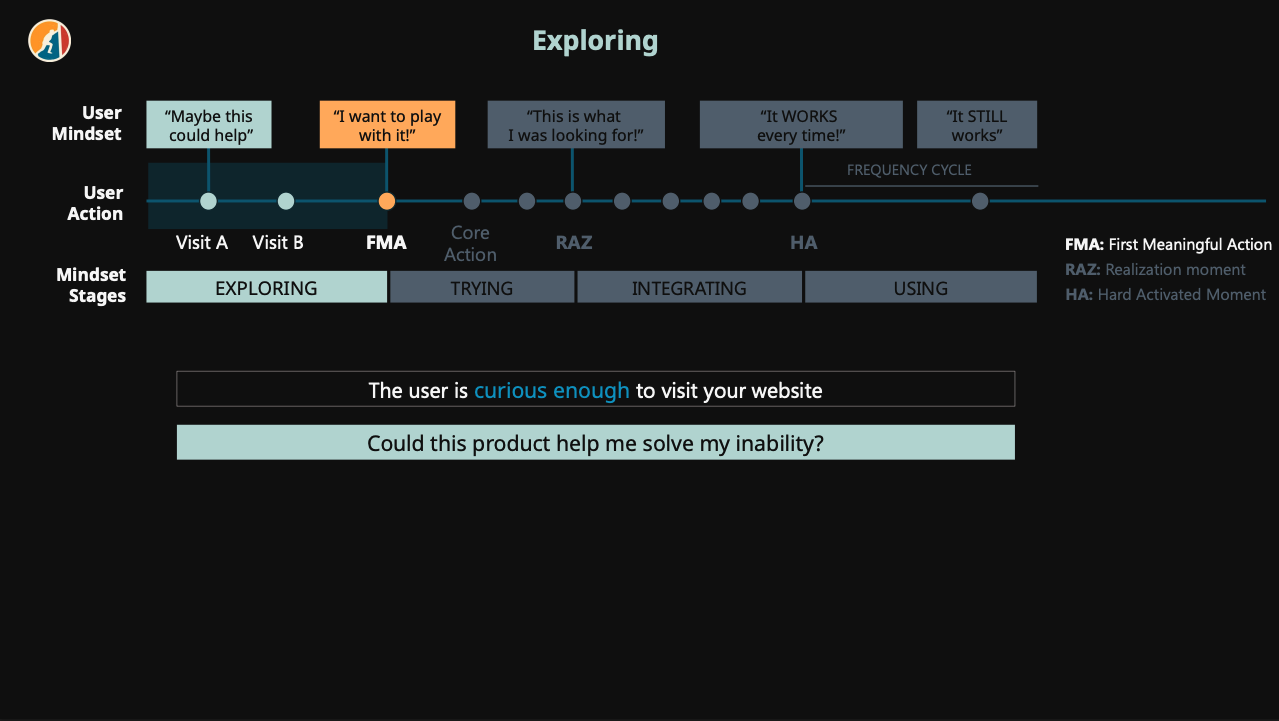
So let’s start with exploring. Remember everything that happens before the first meaningful action, and that is a user that is just curious, like I was on Google, or I saw an app, I’m here. Let’s see what you have for me. Curious about what? She’s not curious about your 52 features. She’s curious about the two features that are going to help her solve the inability. Can you help me? Common blockers there? So people that get stuck as a visit never did a sign up. They got stuck there.
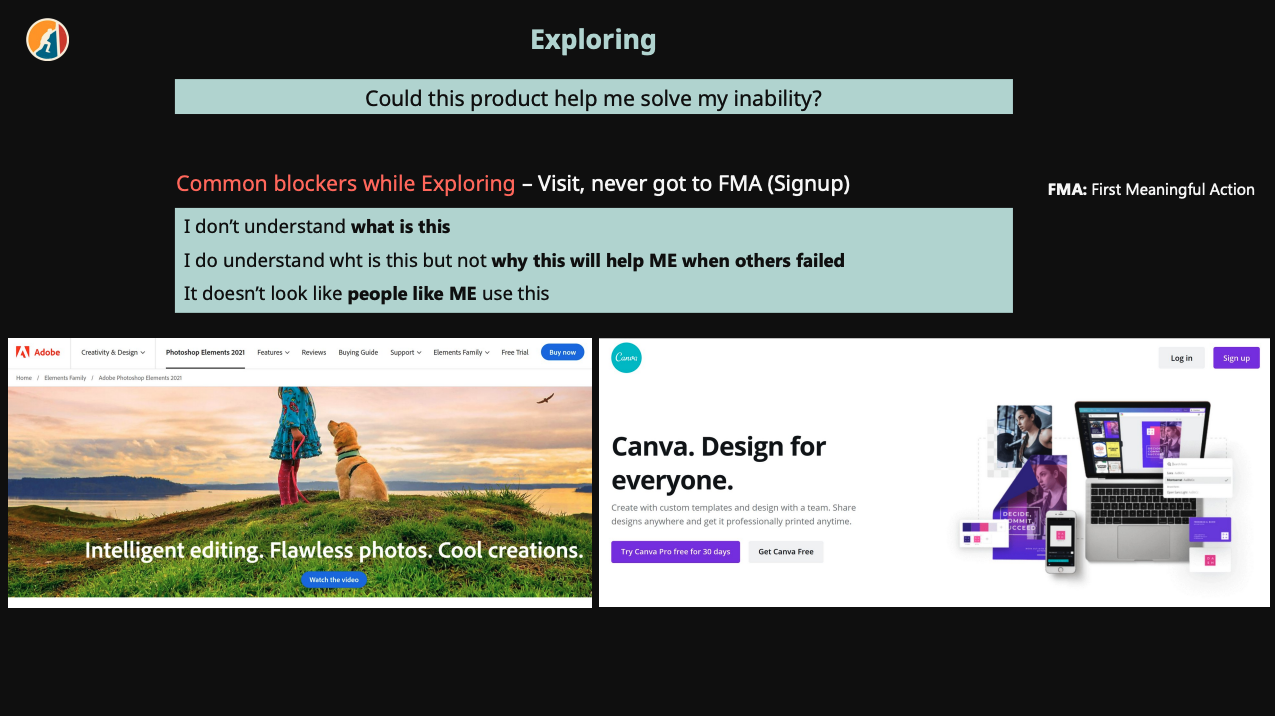
We know. We are aware that people should be able to understand our homepage. Sometimes we succeed and sometimes we don’t. We are less aware of the fact that that person didn’t just try you today and she knows nothing else. No, she’s probably trying 10 different solutions, and all of them failed for one reason or another, and now she’s looking at you, it’s like, you look like the other guy. Like, why you? That is also a blocker. And one way that people have to kind of try to answer that question is like, OK, if this is for people like me, then probably it has the features that I’m looking for. So she was on Google, check the result. Adobe Photoshop Elements, Adobe for Beginners it’s like, this should make sense. So she clicked, Adobe, like, what is this like? Intelligent editing. Flawless photos. Cool creation. Like, what do you do? What is this? It’s a stock photos website talking about like people like me. This doesn’t look like for a content creator. Looks like a professional tool with a professional photo in a format that is, I don’t recognize anything.
So sick guys in horror leaves, keeps checking Google and finds Canva like, Oh, I heard about that. Design for everyone. This day is probably as bad as the other copy. Don’t care that you want to create, like, looks like a communist we work or something like, what are you trying to do with this? But then she looks at the photo, and he’s like, Oh, I totally recognize that. That is how my laptop, exactly my laptop looks like when I’m with Apple photos, the same type of photo, the same format, and now you are putting a filter, drag and drop. That landing page is just saved by that photo, not by the copy. So you can see some first examples of why people get stuck at exploring.
Stage 2: Trying

Now let’s go ahead, like, okay, so I want to play with it, and let’s assume no before we get there, before first meaningful act, between first meaningful action and the realization moment that is between sign up and using it a little bit five times, right? We just want to play. They just want to touch the product. They just want to explore it. They just want to use it a few times. Do these corrections that are not real correction. They are fake corrections. Even for something like Shopify, the first order is not going to be a real one. It’s the owner of the business. Like, trying, does this thing work? Like, do I get the money? So a lot of corrections that go nowhere, but letting me see your home page on paper, you make some sense. Is that true or not? So what are the blockers when you sign up and did maybe zero corrections or one correction.
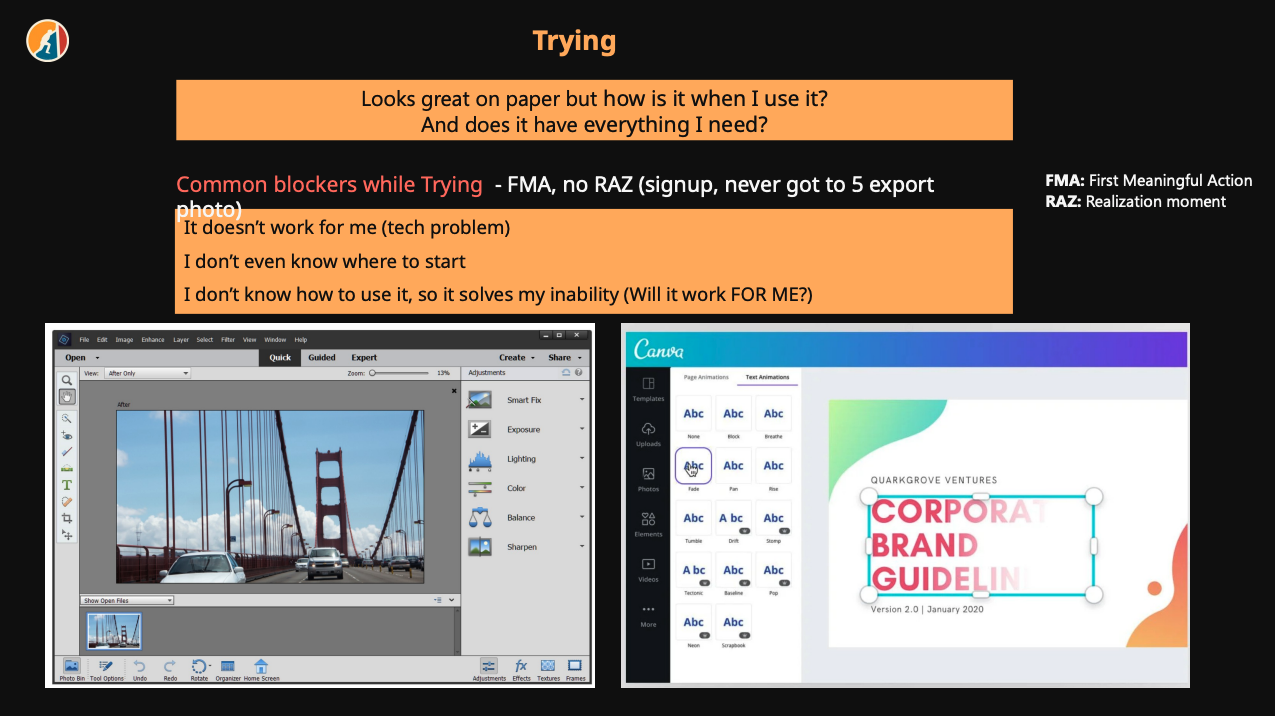
Zero corrections is like, look, just doesn’t even open, right? And that is obvious, although then you talk with customers and you realize that sometimes it happens. But what about like, Okay, this looks like too much. Like, I don’t know where to begin, or I know where to start. I did it a few times, and I still don’t understand why this is faster. Look at the Adobe landing page. I’m looking for quick, and you’re giving me cool creations and stuff like, I want quick. Can you give me quick?
Let’s say that because she thought that Adobe could deliver something she tried. So she found this. I think, like the Adobe developers had Photoshop, and they were thinking, how can we make it simpler for beginners? Like, why don’t we spread all the icons all over the page, that should make it and a critical part, let’s put that four there so it’s not overwhelming.
Where do you start here? What do you do? Also, props for the gray. Like you want to be uplifted when you are using a new probe, you want to enjoy your new tool. And they picked the present gray that is like, a great color.
Then she went to Canva. More uplifting is like, hey. Gave about this kind of pact of things. A lot of elements doesn’t mean complexity. Complexity comes from a lack of a structure. But when you just have something where two icons, like out of the bar with six just templates and photos and elements, these are the things that you’re going to use. Three things you click on a template, you have your display, you drag and drop. That’s it. That is simple. It doesn’t have a lot of different concepts to master. That has 24.
So you see how somebody can get stuck at saying, but still, okay, she stopped with Adobe Photoshop Elements and move ahead.
Stage 3: Integrating
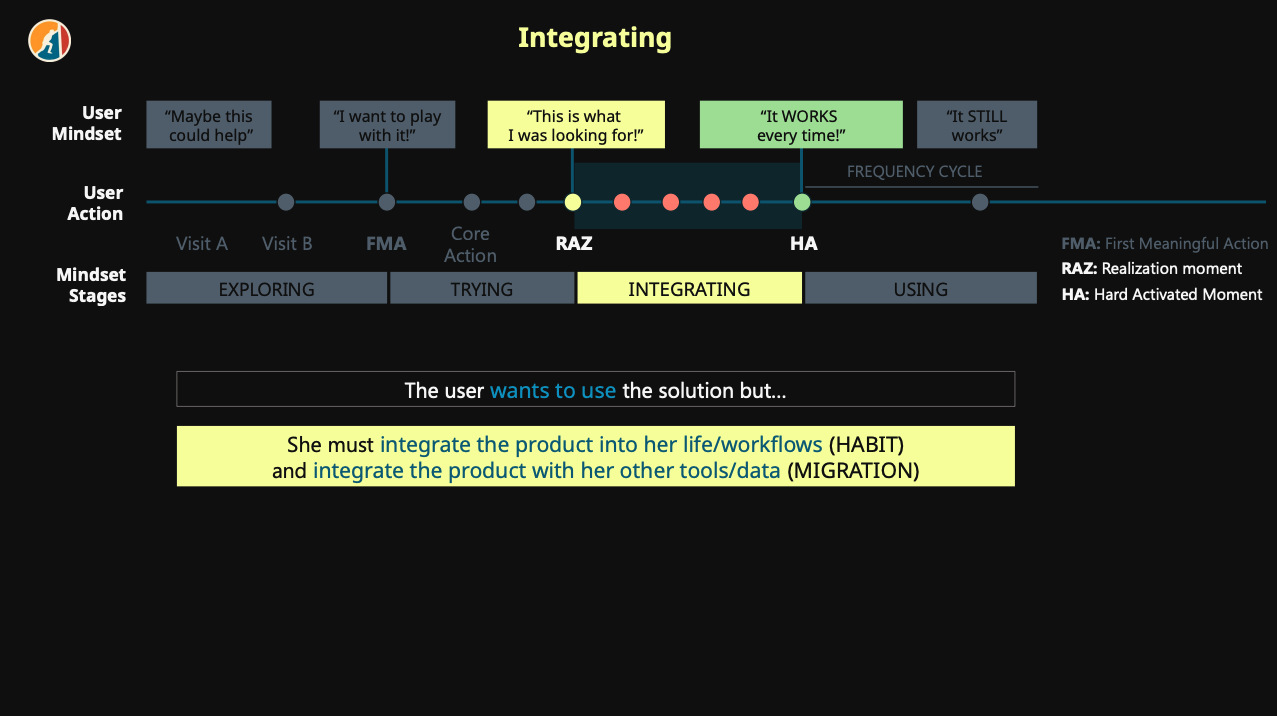
This is not the end of the journey. Now she has to get to, it works every time, so she wants to use it. But what happens? What happens is dependencies, dependencies everywhere. Dependencies with your routines, dependencies with other tools, dependencies with other people, dependencies with your own habits. And each one of these dependencies is getting in the way of our user doing a successful migration. Dependencies with all content that we have and create a habit like, I have to remember that this exists and it’s ready every time that I need it. And so all of that.

Common blockers, and this is a really interesting category that we usually don’t think about it. Somebody that use it five times, 10 times, and then stop. Like so much effort, they came and signed up and play with it and use it a bit more, and then they left. Why? But this is still not retention. There is still a why. The why can be, I’m trying to make it work. I want it to work, but it doesn’t connect. I’m trying to use it with a graphic designer, and the format is not opening properly. I am like, I have all these photos. Like, remember, 15 corrections? The first five were fake, yeah. The next 10, she created, like 35 with final, final, final, final, until she got to the one that wanted to export. Like she was doing a lot of things, has templates that she likes, templates that she doesn’t want to see again. Do you handle all of that? Like is easy, like to see what is going on there.
And then sometimes, when we think about the funnel in this part of activation. We believe that some things are not our fault. Like, oh, that person has a low frequency used case. I’m just going to talk with marketing so they don’t bring more like them. You can also make it your task to help them. Like, how can we help somebody with a lower because that is a block, right? Like, she’s going to forget. It’s not going to be properly set up every time, so she’s not going to use it in the long term. How can you solve that?
Well, what Canva did, by the way, this talk is not sponsored by Canva. What Canva did is embedding themselves in the previous step. So you have HootSuite, that is the place where you go to write the post and schedule the post. Not all the posts have an image. So that’s why maybe it’s an infrequent thing, but when they do, you just have Canva waiting for you there. That is a cool way to help with something that we tend to discard as, oh, this is not our problem, right?
And then we tend to look at okay when we are designing the probe. This is how it looks after some usage, a little bit. Lately, we got better at looking at what happens the first time. Like the blank slate, how does it look? Does it have like indications? But we almost never check what happens after extreme usage, as I was mentioning, like, what happens? Think Slack first day, it’s kind of clean. Couple channels. Everything looks good. Day 10, 50 channels, 20 messages that I don’t know where they are, documents that I completely lost track of it. What happens then? There is a really important part of completing integration, and we rarely check that. Then we talk with our users like I’m so frustrated I can’t find anything by plot of users.
Stage 4: Using and Hard Activation
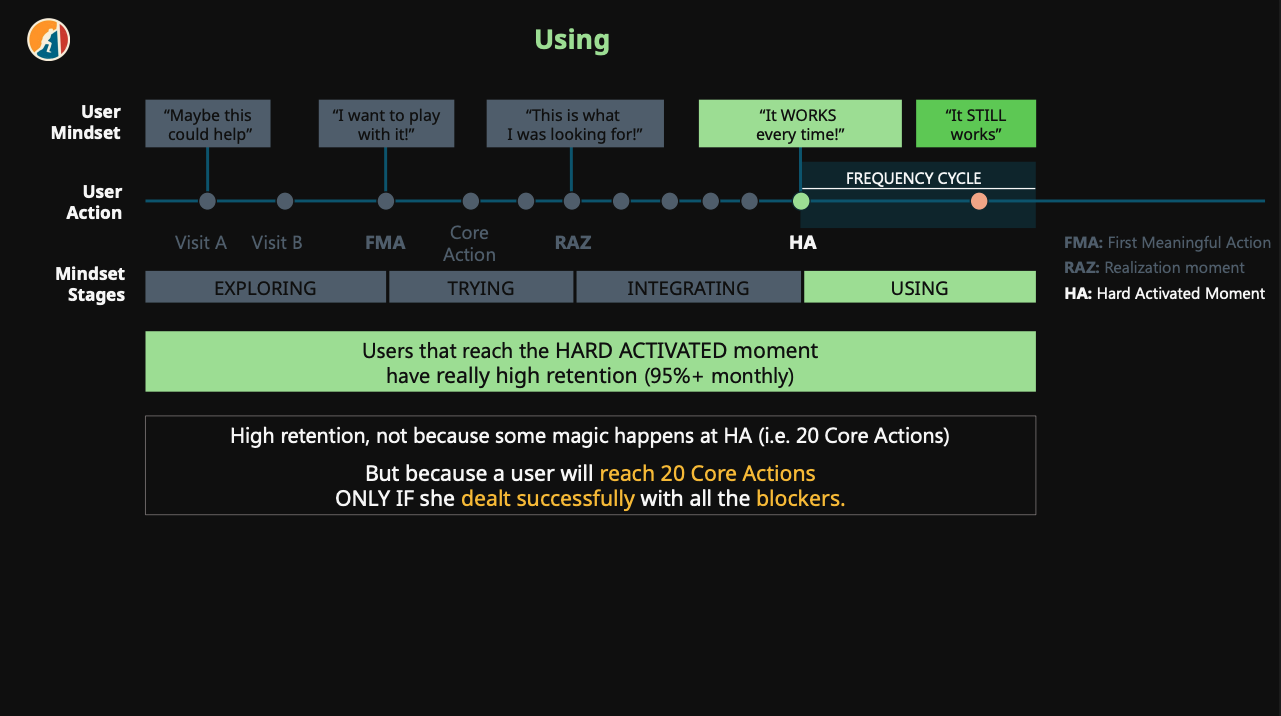
And let’s say that she was successful so she got to the very end using. But the hard activated moment. And what happens here? These guys have activated users, have really high retention. They keep coming. They don’t keep coming because something magical happens at 20. In this example, in your number, your threshold will be different. So this is, what happens at 20 is that you will only get to 20 if and only if you dealt with all the blockers. You run out of blockers. Okay, this thing just works every time, and we can achieve that just extending what we understand for activation from that first correction to something much longer. And now we can see what is going on, where they are dropping. And when we get somebody to the final to the end, becomes hard activated, like, understand what happened also there that everything worked.
Push vs Pull: Improving the Funnel
So now we know that we can’t ask this question, right? How can we play with this? This is the idea of push versus pull. There’s a different push that what Bob told us a moment ago. This is more like company, push versus user pull.
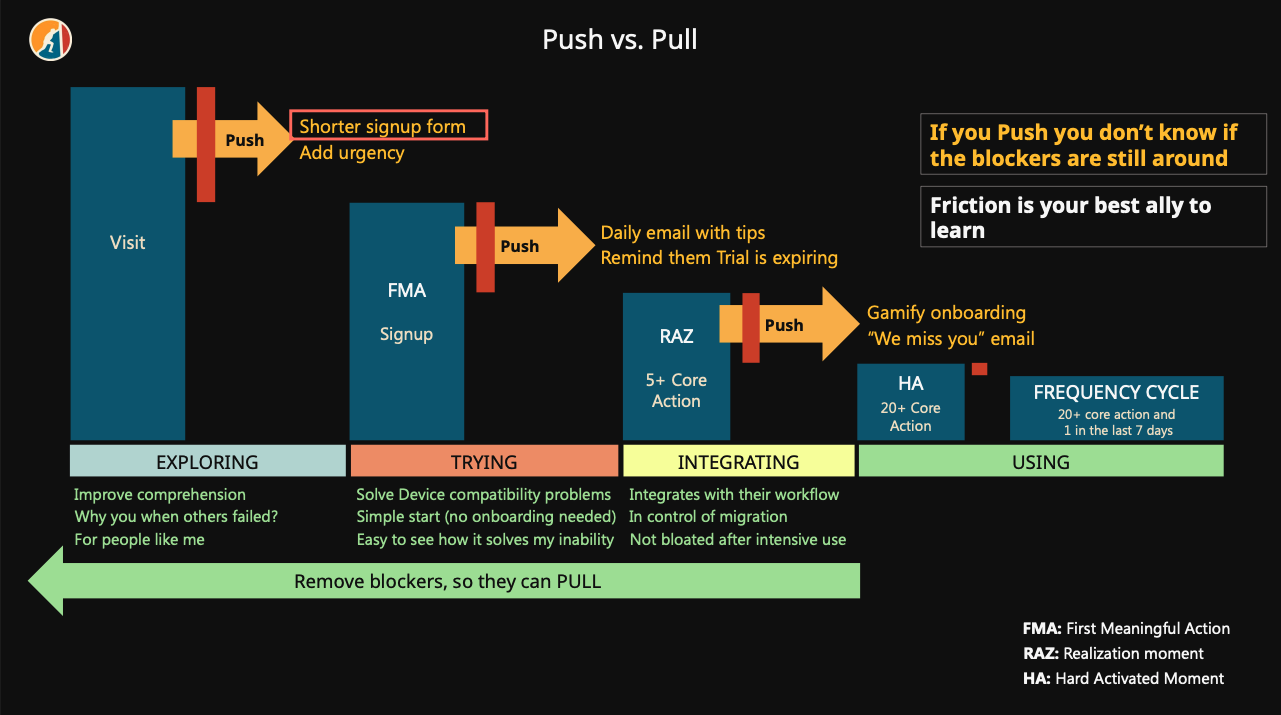
So we have our blockers, and after hard activated, nobody is going to stay there forever, but the block, we lose less people. You can do two things. You can completely ignore the blockers and keep doing your thing. Okay, let’s keep pushing people down the funnel or as we discussed, you can focus on the blockers and do the thing that serves the blocker so they can pull the product. They want it, and the deeper they are, the more they want it at the rush like after five times they really want it. Sometimes they can’t, and it’s different.
Now, nobody ever look at your landing page. So assign a form that is too long, you know, I’m not going to sign up. That will never happen if they understand what you do and why you are completely different. Why you? Then it doesn’t matter. You can put them like 20 fields, and they will go through or waiting for three hours refreshing until you get your oasis tickets. Like it doesn’t matter if you decide the thing you will go through it.
Understanding Being Activated vs Hard Activated Users
So the problem with push is that, in some cases, don’t even work. If I don’t understand your page, doesn’t matter how small the standard form is. In the cases that it does, the problem is that it also adds a lot of noise into the funnel. You have a lot of people that shouldn’t be there, and then you ask them is, like, why did you sign up and then stop using it? Oh yeah, because I’m missing these three things. Like, no, no, but that is, we don’t do that. Like, why did you sign up? Oh yeah, the offer because, you know, like, I didn’t want to miss it and you were talking about cool something, so just in case.
So you have all these people, and even if then you decide, okay, let’s talk with them, you will have the wrong used cases in the wrong part of the funnel, and your metrics will be all messed up.
Now we can flip this. Do you know the best way to build a landing page, like the tightest landing page that you ever built in your life? Don’t push, not a single push. Nothing. You know what? Make the sign up form longer, have friction, and if you do that, the only way that they will sign up is if they understand what you do and they understand why you, right? Now, using friction, we can really learn and see like, okay, are the fundamentals right or not? It doesn’t stop there. We can go even deeper with this, because we have in the funnel, remember, they had activated users because we define them as people that run out of blockers, they have really high retention, therefore low risk. And we will call all these people here the being activated. And the box is not red, because there is nothing wrong with having three correct actions if you just keep doing corrections.
The problem is, when the last correction happened three weeks ago, then we have a situation. But the reality is, like, if you just have three corrections, you use it three times or five there are still a lot of blockers ahead. So there is a lot of risk. And then we have our weekly active users report. Where active is something, usually they open it something. And now you know that even if that graph looks healthy, it’s hiding a combination of being activated and hard activated. So what we have here actually is a situation of a company where you can, at the same time, be alive or dead, and the only way to know is lifting the lid. And when you lift it, it can look like this. Some being activated that you are bringing, they activate, become hard activated so they stay. And you bring more and they stay, so you are stacking them, pretty healthy. No problem there.
Company Patterns: Healthy vs Unhealthy Funnels
But that is not usually what I see when I do this with companies. I find this. You bring some people, nobody’s using it, so you push them with emails, with confetti, with whatever you have at hand, and because it looks like it’s working, you increase budget, and you keep pushing, because it also looks like it’s working, but the blue guys are not spending money. So it keeps going up. Your average value per user keeps going down, and you don’t know exactly why. Well, maybe lower quality. No, they are all of them dead there. And one day the CFO comes to you, like marketing stop. And you know what happens? This happens. In two weeks, all the being activated that you are not refilling the funnel disappear. And I did that with companies too. It was like, okay, look, we are going to do something. It’s going to be traumatic, but it’s for the best. And we stopped pushing, and we stopped like, this bad acquisition, and from there, now we can start working and solving this situation.
Wrapping Up the Activation Journey
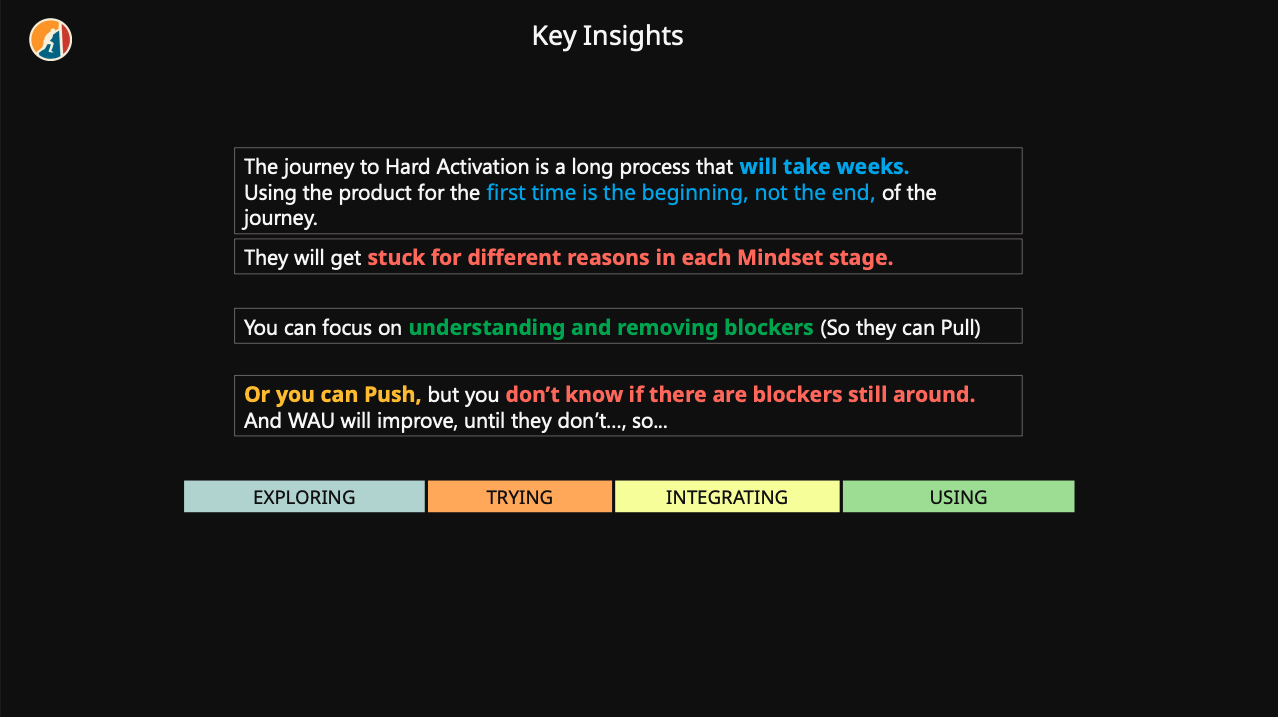
So let’s wrap it up. Activation is not 10 minutes after sign up. Activation is weeks of using the product and running out of loggers in the process. They will get stuck with different reasons in different stages. As we say, somebody that reads integration, understands what you do, thinks that is interesting, why you are different. I played with it so all these blockers were solved. The blockers that somebody has at integration are completely different than somebody at exploring that is like, I know nothing. Tell me what you do. Where you have two options? Understand these people, the blockers, and remove them so they can pull, or, as I say, you can ignore that, and you can push. And the blockers are still around, and the metrics look good until they don’t. It’s up to you, but if you want my tip, please don’t push. Thank you very much.
Want more of these insightful talks?
At BoS we run events and publish highly-valued content for anyone building, running, or scaling a SaaS or software business.
Sign up for a weekly dose of latest actionable and useful content.
Unsubscribe any time. We will never sell your email address. It is yours.
Mark Littlewood
Right questions.
Audience Member
When you’re diagnosing the drop off during this funnel, you’ve given a few examples of reasons people could drop off. A thing that we have found is that people who have dropped off the side. This isn’t for them hit any one of these challenges are blooming difficult to get on the phone to talk to. How do you find out what it is they are bouncing off?
Diego de Jodar
So remember what we just did is finding a way to measure it right? So now you can measure and you can create a list of people that use it five times and not 10. For example, if that is your case. Now you can talk with them.
Audience Member
How do you get them talk back?
Diego de Jodar
Okay, so there are different ways to do that. For B2B, it’s kind of natural that you start a relationship with them. Now with PLG, like, no, no, we are self service. Okay, don’t. Like do your self service, whatever. Keep talking with some of them and build a relationship. And when they drop, you know them, and you have access to them. Since the beginning, when there is desire, where they really want to use it, that is going to be much easier. So that is kind of the easiest hack.
The second hack is called a $50 Amazon card, and that for half an hour just works seriously. And you can think, but that biases people. No, I try that all the time. It doesn’t. In fact, they kind of feel that they have to be pretty honest and brutal with you, because you are paying them to be that so you get really good feedback. I have a team that just gave teasers to the users. And there is a point here. If you just talk with people that drop, you’re missing half of the picture, the same as if you only talk with people that succeed. That is usually the case. You’re like, okay, let’s talk with users. We send the emails. The one that are going to reply are only the good ones. The good ones that also can be misleading because, oh no, the product is incredible. I love it. You check four corrections like you love it, but it’s early. But when you only talk with good, the good users, you don’t know what is the dimension that makes them good. You need contrast. So you need to both talk with the good users and the bad ones, the ones that drop. And it’s via this contrast that you start understanding, oh, this case, under this situation, they drop here. With this case, they never get to the end. But to be able to make that assessment is here stuck or they never get to the end, you need to know who is in the end and who is dropping right? So create a relationship or pay them the quickest hacks.
Mark Littlewood
Max, it’s your first time. So I just wanted to thank you for asking so many questions.
Audience Member
So this was extremely appropriate, because I was setting up conversion tracking this last few days. On all of the metrics you’re talking about, and I’ve only just launched my app not that long ago, so trying to get a good picture of these things, and the thing I’m trying to understand is that big gap. I see this in ads as well, a lot, by the way, of like sign up to purchase, and there’s this big gap in the middle of the activation so I think everyone should track all of this stuff in all of your ads and everywhere else. And that will be a huge thing for me. My question is, I don’t there’s lots of types of activation metrics, and obviously say, if it’s Instagram, it’s you’ve scrolled a certain amount, or something like that. But for us, it’s a weekly planner app. That’s the simplest way of describing it. So it could be planning a week, or it could be building a card, or a certain number of cards, or logging back in. And I’m kind of toying with the idea of it might be good for many of us to combine that into like a single thing, of like, did the person sign in three times, build two weeks and produce 50 cards or something. So do you do that, basically? Do you kind of combine multiple actions into a single kind of unified activation metric? Or do you prefer to do it otherwise.
Diego de Jodar
I would not do that. The reason is.. I define here the correction as something kind of specific, because it’s also a narrow probe that you can only do one thing, and now you are telling me, Hey, if you can do a lot of things, so they have a lot of corrections combined. You can think about it in a different way. Let’s define your correction as session, just a session. But one session is meaningless, right? And I complain about it in the weekly active users. Yes, 100 sessions is not meaningless. It’s extremely meaningful.
So if you use sessions, you’re doing something. You’re covering all used cases. If they keep doing sessions, it’s because they’re seeing value. You don’t know which one, but there is value. You don’t get to 50, you don’t open it 50 times unless there is something there. Because nobody is forcing, unless you are forcing them to come back. But even pushing, you’re not going to get them past them right.
And now, when you measure sessions, you can also have for that individual user, you have a threshold based on sessions, and then individual metrics, all these other metrics that you have in mind, like, okay, stuck at 10 sessions last one, three weeks ago, so that guy is gone, what is in the middle? And then you look at all the other things, and you will see patterns. You will see use cases there. Then you talk with them. Don’t try to get make the data tell you more than what is there. The data should only be used to point you to the right user to talk to. That’s it. Because the rest are just like stories in our heads that we build about why that person that uses that way is stuck there. So when you have a product with a single use, something like spark photo, like narrow correction, great. If not, I always default to session, and it works great because of the thresholds.
Audience Member
From your perspective, would a sales onboarding call be a blocking remover or more like a push? Like, you know when someone guides you through the product and so on.
Diego de Jodar
Great question. If you have that, that can perfectly be the first meaningful action, because they are doing an effort now. So you can use it as a way to split the funnel between people that are there are not interested, but maybe because they don’t understand what you do, and the ones that request that call us, they have some motivation, and then you can work with that. So you can use it as a first meaningful action, or you can move it later, have a sign up that is a smaller effort, Right? Like a smaller first meaningful action, see who passes there and then out of the ones that sign up but don’t do the onboarding call. You have another group there that something is not working. Instead of spamming them with emails, try to talk with them to see, like, okay, to sort some interest, but not enough what’s going on there.
So, and you can do that with, like, that’s the interesting thing with the funnel, that you can think also, like, how long do I do the free trial? Right? What I recommend is, like, don’t make it a blocker at the beginning. If you don’t know how long it should be, just double it, you’re like, Okay, 60 days. So you know that if people drop there is not because you force them. Just stop them, and they have to make a hard call about, do I use it or not? No, they drop because they want to drop. So it’s giving you better signal than just having a free trial that is too short, so you can always. Once you understand the ideas, you can play with the funnel to get the maximum amount of information from them. Make sense?
Audience Member
For most of, I guess for a lot of the founders here, will only see one product or one one set of this funnel, and that makes it hard, particularly if you haven’t been through the journey before to what does good look like in terms of conversion rates? I know it’s a piece of string question, every company will be different. But what are there places that you can find out or or place? What? What you know, at what point would you be worried if you’ve got 10% going through or nine or 3% going through?
Diego de Jodar
So that’s a great question. Like, Hey, do you have benchmarks for this? How does this look like? I work with a lot of companies. I did deal with hundreds of companies over like, eight years. And you can have two companies that work in the same space and have, like, a pretty similar approach, and the numbers are completely different.
So I also started using benchmarks, and then I stopped using benchmarks, because it’s like, Look, you map it, you have your first like set of drops. That’s your benchmark. And now move from there. Because usually, like, there are so many elements that affect like, when they drop, and why they drop, who you are bringing, and how does connect with them? And we have other elements, like brand, as I mentioned, like, if you have a strong brand, like, people are gonna get much farther than if you’re a total unknown, and they just bounce on the homepage, right? So because of all these elements, benchmarks are really inconsistent. And when you read any benchmarks about anything. They say, why they buy wildly like, yeah, of course, because you are trying to mix things that shouldn’t be put together. So, yes, make your own measurement. That’s your benchmark. Now improve it.
Audience Member
I guess the challenge there is that you’re potentially going to invest a lot of time and resources to go and do I rebuild this thing, or is it fine? And it’s hard to make that judgment with without any sort of.
Diego de Jodar
So when you’re talking with both extremes, the ones using it and the ones that drop, you get closer to make that assessment, because when doing that process, you’re not only finding blockage, you’re also finding who are your users, different segments, right? And in a lot of cases, they end up realizing, after doing this exercise, like, oh no. Like, we have to pivot in this direction. We were talking with them. We are really kind of a different product of what we believe, and this is the right segment. So you kind of, it’s not about you do this. Now we have three blockers. Let’s remove them. We are all then, no, it’s like it can have bigger strategic implications. And that is what is going to inform like, Is this too bad or not? Talking with both is going to help you there.
Mark Littlewood
Thank you. So it’s interesting. It might be really easy to make the leap that this is about funnels and having a website, and going from uninformed and not problem aware all the way through. How does that prior to enterprise sales. Now, we had a series of talks at BoS USA 2023, where one of the things that was talked about was a company called Autobooks, who were selling to banks, and they did one weird thing. One weird trick that had a massively significant effect on their activation and their users. That weird thing was changing the comp of the sales people from signing an order to having activated accounts. Bob, give a little bit more context on this? Because this is quite an interesting thing, because it’s like people like sales, people don’t care about that, but if their commission’s tied, yes, they do.
Bob Moesta
Yeah. this is a case study where, as they started to scale, the fact is, is they would get lots of leads in. But the fact is, they weren’t able to convert them, or they’d sell them. And then what would happen is the back end of the process of implementation was so hard because it would be sold to, let’s say, a bank VP, and then it would be sold to, it’d have to be they’d sign a contract, and everybody else along the way would have to be sold. And so what they did is they changed the process to say, like, no, if the bank BP wants to see it, now you need to bring in the rest of your team. And so we’d actually front load the activation part of it. And then at the same time, what happened is customer success would be actually be pulled into the sales process.
And then the second part was the sales people only got 50% of the commission when the deal closed, and the other 50% when they reached the goal of what the activation was. And what was so interesting is it then got sales so motivated to basically make sure that they got the activation right. That’s how they actually got to the hockey stick. And so it was simply just re renegotiating with the sales people, and they lost a few sales people because of it, but at the same time, the sales people ended up doing less work and making more money by redesigning the way the activation worked.
Diego de Jodar
Nice. That is a flawless implementation. For B2B, like, okay. Go with them, sales and customer support until hard activated. But when I work with B2C companies, you can do the same too. Like, once you have that, you will start seeing how long, on average, tends to take to get to her activated, 3/4/5 weeks. Okay, you have to care a lot during that time. You are B2B, and you have direct contact, as we discussed before, okay, just be on top of it. But if not keeping in them, try to create also relation at the beginning. Try to have a whole team thinking not about, What else do I add into the funnel? How many more budgets or stuff? But what is stopping them? Keep talking with these users and give them incentives. If that is what is needed, it’s great.
Bob Moesta
Do you believe in reducing friction? Or is there points where you actually need friction?
Diego de Jodar
So great question. At the beginning, as I said, when you know nothing, you want to leave the friction there, or even increase it, so you can learn. Once you learn and now you know what you are doing and who is coming, then you can reduce it. But it’s not one of the other.
Bob Moesta
That’s kind of the point is that you need to pick where you need to have friction points, because they actually save you sales people, they save you a lot of activation and and where they’re not ready yet. And if they’re not ready, if you put, I call it a speed bump, you create a speed bump. But that first thing that slows them down and they’re not ready, it’s like if, but if they go over it, they’re going all the way. And so, how do you actually design those places? That’s great. Thank you.
Audience Member
I just wanted to add one extra bit to that as well. Is that also a common thing that I think with B2B, we were talking about, like, really big sales cycles, and this kind of problem is your marketing, you’re like, Well, I don’t know what happens, because the sales cycle is, like, two years later that someone goes ahead. But if you track all of those steps, then you can actually be much smarter with your actual conversion tracking and marketing, because you can say, Cool, I can get sign ups easily. Anyone can get 1000s of sign ups from Google ads. But can you get even if you just track that first core action like they did actually at least export a photo or, you know, X, Y, Z, that’s dramatically different to the results you’ll get back from your marketing if you can even get one inch further down the funnel.
Bob Moesta
In that sense, what I try to do is, in that first entrance, I try to get them to actually pitch which job they’re in, because now I have a commitment to what progress they’re trying to make, which then actually leads to everything else. And so getting them to just have a say, a broad awareness, doesn’t do me any good. I got to know, why are they there? What are they like? What are they hoping for? And once you have that, then you can actually track a lot better.
Diego de Jodar
Yeah, great point. And the thing is, as you say, kind of easy to get sign ups, and then you just measure that first correction, and you see a drop, as we discussed a moment ago, even if that correction is says, You will not believe the size of the drop per session is incredible. And the good thing with a small correction, either, when you see that they don’t even open it again because export photo can is like, oh, maybe they did something, but they don’t like it. No, no, they didn’t open it, then there is no ambiguity there. It’s like, okay, no, like, there’s a problem there.
Mark Littlewood
That’s good. Diego. I stand educated and in awe. Thank you.

Diego de Jódar
Founder, Please don’t Push
Diego’s experience after founding 6 startups was that something was not quite right with the conventional way of making startups growth, so he spent the last 8 years developing new approaches to growth that were successfully implemented in the more than 100 companies he mentored around the world in collaboration with global accelerators like 500 Startups and TechStars.
