Most startups follow a familiar script: raise money, grow fast, and figure out the rest later. Buffer, the social media management company with over 1.7 million users and $4.25M in annual revenue, chose a different path.
At the center of this story is Joel Gascoigne, Buffer’s co-founder and CEO, who believed from the very beginning that building a company was not just about growth. It was about doing it the right way.
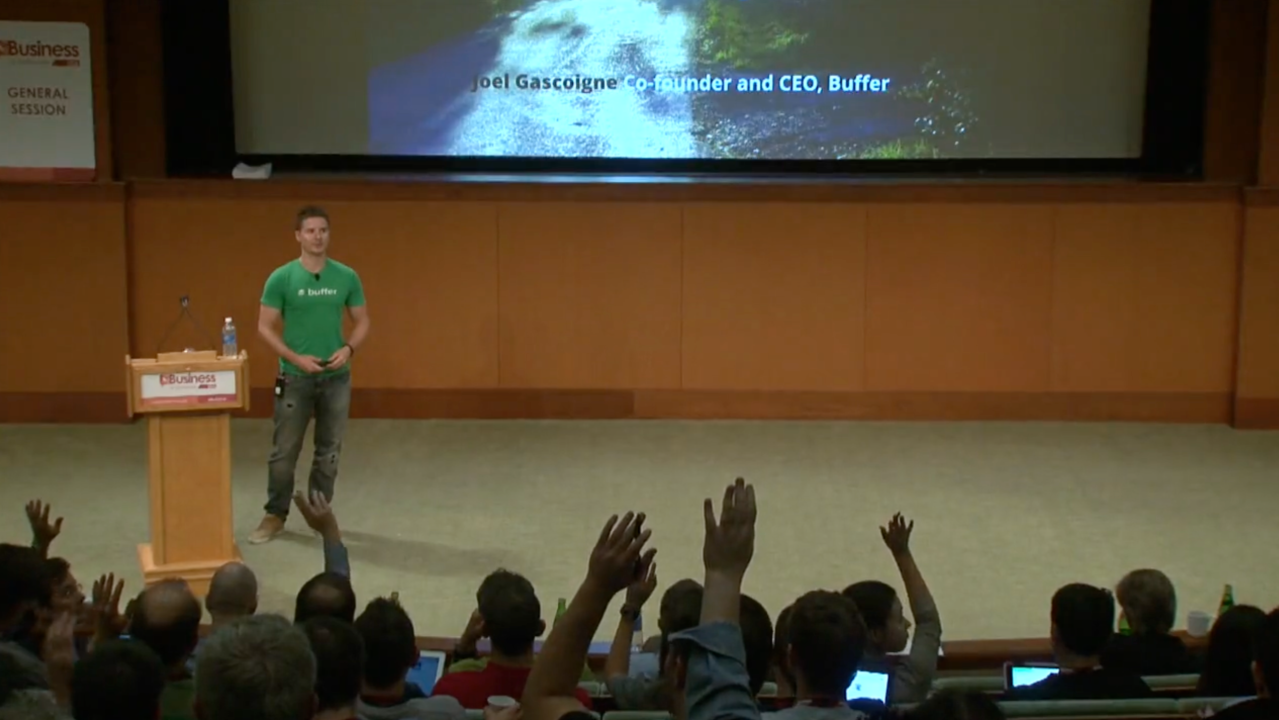
Joel first shared this journey on stage at the Business of Software Conference USA in 2014. Fast forward 11 years, and he is returning to the BoS Conference stage with a very different story to tell. Over that time, Buffer saw its annual recurring revenue dropped 20% over a four-year stretch, fought through the challenges, and rebuilt stronger than ever. Today, Buffer sits at new all-time highs with $22.3M ARR.
But to understand how they got here, let’s rewind to the early days.
Buffer’s early days looked like any other scrappy startup. Joel launched it in the UK, bootstrapped it to $10,000 in monthly revenue, and eventually raised $450,000 in seed funding in San Francisco.
Then everything changed.
Visa issues forced Joel and co-founder Leo out of the US. What could have been a setback turned into a turning point. They worked out of Hong Kong, Tel Aviv, and other cities around the world. That nomadic chapter planted the seed for what Buffer would later become: a fully distributed company.
Transparency
Joel had always been candid online, sharing his startup learnings publicly. Buffer took that instinct further than almost any company before it.
They decided that unless there was a very good reason, everything would be transparent.
- Salaries: Not just shared internally, but published for the world to see. Joel’s own salary of $175,000 is right there in the spreadsheet, along with everyone else’s, determined by a public formula.
- Emails: Every team member can see every departmental email, inspired by Stripe’s radical openness. That means a customer service rep could peek into marketing’s back-and-forth with TechCrunch.
Why go so far? Joel says transparency:
- Builds trust as the foundation of teamwork
- Levels the playing field by removing bias from pay
- Invites feedback to refine processes
- Draws talent who want to work in an open culture
And of course, it attracted media attention and thousands of job applicants every month. But for Joel, the media buzz was secondary. Transparency was not a tactic. It was simply the “right thing to do.”
Values and Culture
Most companies let culture form on its own. Buffer made the opposite choice.
Influenced by Zappos’ Tony Hsieh, who once wished he had defined values earlier, Joel and Leo sat down with their team of 7 to 8 people and put words to the culture they wanted.
And they did not settle for vague platitudes. Their values were strikingly specific:
- Always choose positivity and happiness – not just optimism, but the discipline of gratitude and appreciation.
- Be a no-ego doer – move fast, let go of ideas, and avoid getting stuck in “being right.”
- Listen first, then listen more – make suggestions instead of pronouncements, and prioritize understanding over winning.
This clarity made tough calls easier. Over time, Buffer let go of 15 to 20 people, not because they were bad at their jobs, but because they did not align with these values. Joel framed it as an act of respect: keeping someone in the wrong environment was “stealing a portion of their life.” Many of those people thrived elsewhere, including former co-founder Tom, who built Sqwiggle, a tool Buffer still uses.
Now, every hire goes through a culture interview and a 45-day trial to make sure the fit is mutual.
Distributed Team
The visa detour had shown Joel and Leo a different way to work. Instead of fighting to be in one place, they embraced being everywhere.
Today, Buffer is a fully distributed team of 25 across continents. The advantages are clear:
- 24/7 customer service across time zones
- Flexibility to work from home, cafés, or co-working spaces
- A more humane pace of work, as tasks “pass the baton” across time zones
And the perks are remarkable. Unlimited vacation, plus a $1,000 annual vacation bonus (plus $500 for dependents) to make sure people actually take time off. No commute. The freedom to work from Bali, Hawaii, or a local coffee shop.
Connection still matters, so every five months the entire company flies to a new city like Cape Town, New York, or Thailand for team retreats. Those weeks build the glue that keeps the distributed model working.
The Bigger Lesson
Buffer is not just a social media tool. It is an ongoing experiment in how companies can work.
Joel once said a company is “a great vehicle for experimenting, changing things, and doing what you believe is right.” That spirit runs through everything they do: radical transparency, values-driven culture, and a global-first mindset.
It is proof that you do not have to follow the standard playbook to build a thriving business. Sometimes, the detours and deliberate choices create something even stronger.
This article draws on excerpts from Joel Gascoigne‘s talk, “Can You Build a Business Based on Some Core Principles?“, at Business of Software Conference.