Have you ever felt like your team is full of energy, busy, and working hard but the company still isn’t making the progress you expect?
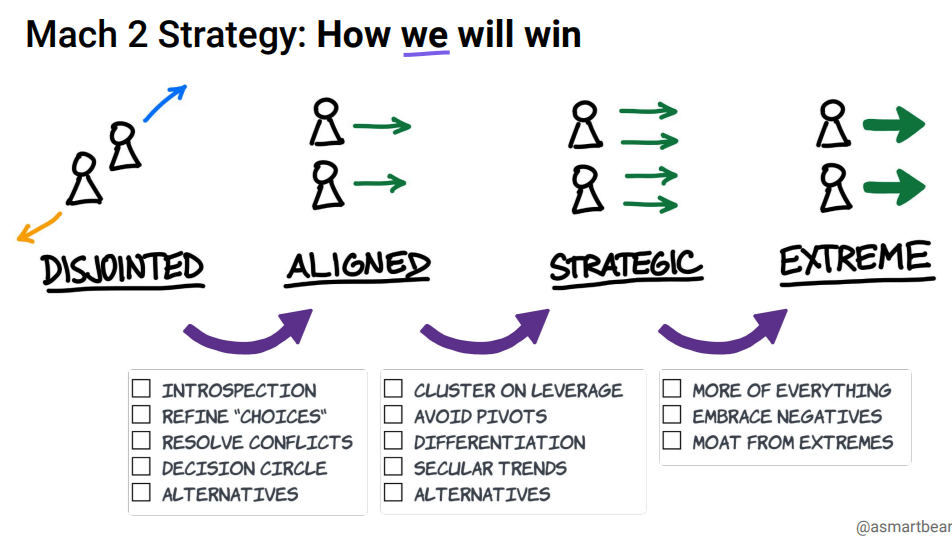
It’s a common problem: your team is moving fast, but in different directions. Like molecules in a glass of water – moving rapidly, yet the water doesn’t go anywhere. Without alignment, energy is wasted.
This misalignment shows up everywhere:
- Support teams over-serve small customers.
- Product teams prioritize feature requests from one big client.
- Marketing crafts messages so broad they connect with no one.
- Designers bounce between too many personas.
Everyone is optimizing locally. But the business as a whole isn’t moving in a single, powerful direction. That’s a strategy problem.
What Strategy Really Means
Jason Cohen, founder of WP Engine, puts it simply:
“Strategy is the set of high-level decisions that ensures everyone is moving in the same direction.”
It’s not about choosing best practices. It’s about choosing how you will win and making sure the entire business is aligned to that approach.
You don’t need a 60-slide deck or academic frameworks. You need a process that works in the real world, especially in fast-moving industries like SaaS.
Step-by-Step: A Practical Strategy Framework
1. Understand the Strategy You’re Already Following
Before making new decisions, observe what choices your team is currently making whether they realize it or not. Don’t just ask what your strategy is. Look at behavior:
- What do competitors say about you on sales calls?
- What do customers praise or complain about?
- What are your people proud of?
- Where does your product naturally excel (or struggle)?
- What do you say on your homepage… and is that what you actually deliver?
These insights reveal the real (often hidden) strategic choices you’re living with today.
2. Make Smart, Coherent Choices
Now that you’ve surfaced the implicit decisions, ask: What’s the alternative? If you’re known for affordability, could you win as a premium solution instead?
Crucially, assess the consequences of each choice, not just the “pros and cons.” For example, “white-glove service” is great, but it’s expensive. That matters only if your business model can’t support it.
3. Align All Choices into a Coherent System
Conflicting decisions will cancel each other out. You can’t be the lowest-cost provider and offer 24/7 personalized service.
Create a “Decision Circle”:
- Red lines = conflicting decisions
- Green lines = self-reinforcing choices
Ask: What would have to be true for this to work? Example: Want white-glove service and low delivery costs? You might need “elegant simplicity” as a core product principle to reduce support volume. This alignment turns scattered tactics into a unified strategy.
4. Layer in External Realities
Once internal choices align, factor in the outside world:
- Superpowers: What are you uniquely great at? Double down.
- Pivots: Where would you have to change significantly to win? Limit these to one or none. Pivots are expensive.
- Competition: What are they committed to? What are you uniquely positioned to offer?
- Trends: Are macro forces helping or hurting your direction? AI, changing buyer behavior, economic shifts. These all matter.
This external layer helps you sharpen your positioning and spot market opportunities your competitors might miss.
5. Go to Extremes: Build a Moat
The final step is to commit – even to the uncomfortable trade-offs. That’s how you build a moat.
Look at Southwest Airlines:
- No meals.
- No travel agents.
- One type of airplane.
These “limiting” choices created a system that was unbeatable on price, punctuality, and frequency. They weren’t trying to match their competitors, they were playing a different game entirely.
Or Craigslist:
- Zero emphasis on design.
- No growth team.
- No innovation for years.
And yet? Massive revenue, low overhead, and a niche no one can touch. Because the whole system is coherent and extreme.
When Strategy Works, You’ll Know
The best sign of a winning strategy? Your team says no to ideas that don’t fit.
You’re not chasing every opportunity, you’re focused. And because your entire company is aligned behind a shared direction, progress feels faster, easier, and more consistent.
That’s what it means to operate at Mach 2. Fast, focused, and impossible to ignore.
This article draws on excerpts from Jason Cohen‘s talk, “Building your Permanent Defensible Strategy“, at Business of Software Conference.