I had no idea what BoS OS was when I joined. I’d used AI tools before, sure, but just on my own, for my own stuff, no different from how a lot of people are dipping their toes into AI right now, half curious and half unsure it was worth the time. Then I walked into Business of Software right in the middle of a much bigger shift, one that started after a talk from Tim Barker got everyone in the room thinking differently about what AI could actually do for a company like ours. That talk is part of why BoS OS exists in the first place. I just happened to show up while it was still being built.
No map, no handover
Nobody handed me a system on day one. Jann was out on maternity leave. Mark was buried in conference prep. The person who had my role before me had one week left before she was gone. Great timing all around. There was no drive with everything sorted. No map of how anything worked. I inherited a pile of systems nobody had time to walk me through, and I did not know where to start.
There was no proper system yet, so I built one for myself, temporarily, just to keep things moving while we figured out the real one. We’re still figuring it out, honestly. The first thing I actually wrote down was our passwords. Not exactly the heroic starting point you’d expect.
The real work started with a meeting.
No onboarding doc existed. So I made one live, during the call, asking every question I had while someone answered. Whatever came back, I typed straight into a Google Doc as we talked.
That document got me through those first weeks. I built it out of pure necessity, not because anyone told me to.
Making the system fit me
Even with that doc, BoS OS itself felt like a lot to take in, the whole way we worked had changed at once, and some days I couldn’t tell what my actual job was anymore.
Then Mark said something that stuck: BoS OS is supposed to make our lives easier, not add more work on top. I stopped trying to force myself to fit the system and started making the system fit me instead.
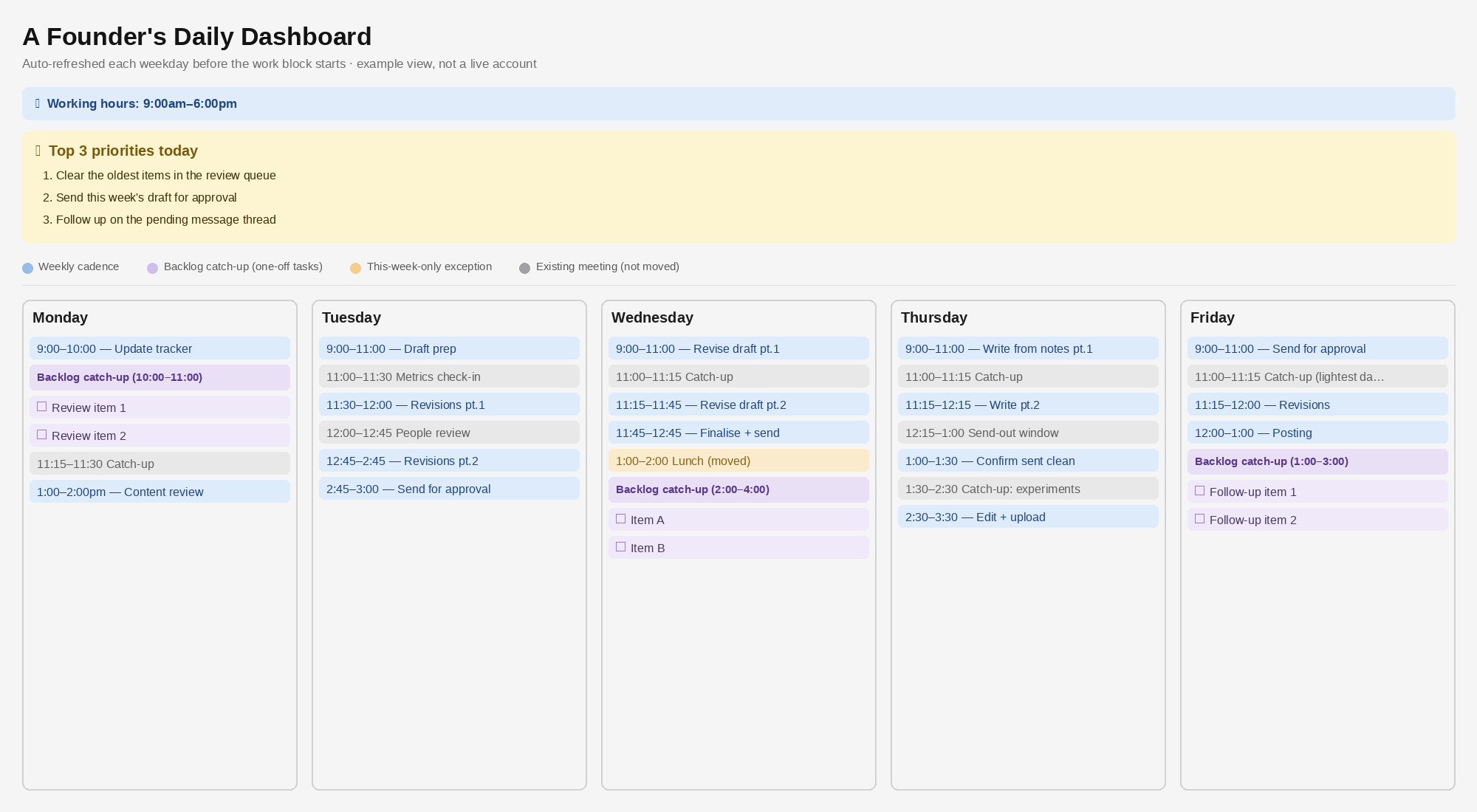
I have ADHD, and a wall of text will lose me every time. So I told the OS how I needed it to talk to me: plain language first, the simple version before the technical one, and show me, don’t just tell me, because staring at pure text for too long pulls me somewhere else entirely. I built myself a dashboard where every task lives, and I cross it off when it’s done. Watching that happen gives me a kind of satisfaction a text reply never did. I even taught it to call a hard stop when I’ve hit my limit for the day, because left on its own, AI will happily pull you down a rabbit hole for hours and act like that’s normal.
That is when BoS OS stopped being something I opened and used. It started working with how my brain actually runs, and started helping me decide instead of just answering.
What’s still unfinished
We are still fixing things. Naming conventions are half sorted. Sync issues are getting better but not solved. What is different is what the process itself surfaced: parts of BoS that had been broken for a long time and nobody had noticed, workarounds nobody questioned, extra steps that never needed to exist. Building this properly meant we couldn’t look away from any of that.
My own role got clearer too. I know what is mine to own, what BoS OS can carry for me, and what still needs my hands on it directly. The manual grind that used to eat my whole day is mostly gone now. What is left is room to actually work on growing BoS instead of just keeping it standing.
If you’re new somewhere and you got handed a mess with no map, I get it. I wasn’t trying to fix anything. I just needed a way through mine.
If you’re staring down that same pile with no map, that’s exactly what the Introduction to BoS OS workshop is for. Two sessions, real example, no jargon required to start.
Learn how great SaaS & software companies are run
We produce exceptional conferences & content that will help you build better products & companies.
Join our friendly list for event updates, ideas & inspiration.