At BoS Europe 2025, Ryan Singer, author of Shape Up, opened the conference by tackling one of the most persistent challenges in product development: how we use our time.
His talk, “Framing and Hard Conversations” wasn’t about productivity hacks or squeezing more hours out of already exhausted teams. It was about something much more fundamental: how to use our time and getting clear on what we’re actually trying to solve.
Ryan has this way of making you realize that half the stress we feel in product development comes from chasing problems we haven’t properly defined. We jump into solutions, scope expands, engineers stay blocked, and suddenly everyone is busy… but nothing is really moving.
What he reminded us is that the most valuable thing we can do is slow down long enough to frame the problem properly.
1. Framing x Shaping, Problem x Solution
The primary challenge is that pressure to build comes from various corners of the business, often leading to dragged-out projects and busy, blocked engineering teams. Ryan introduced two critical concepts to manage this flow:
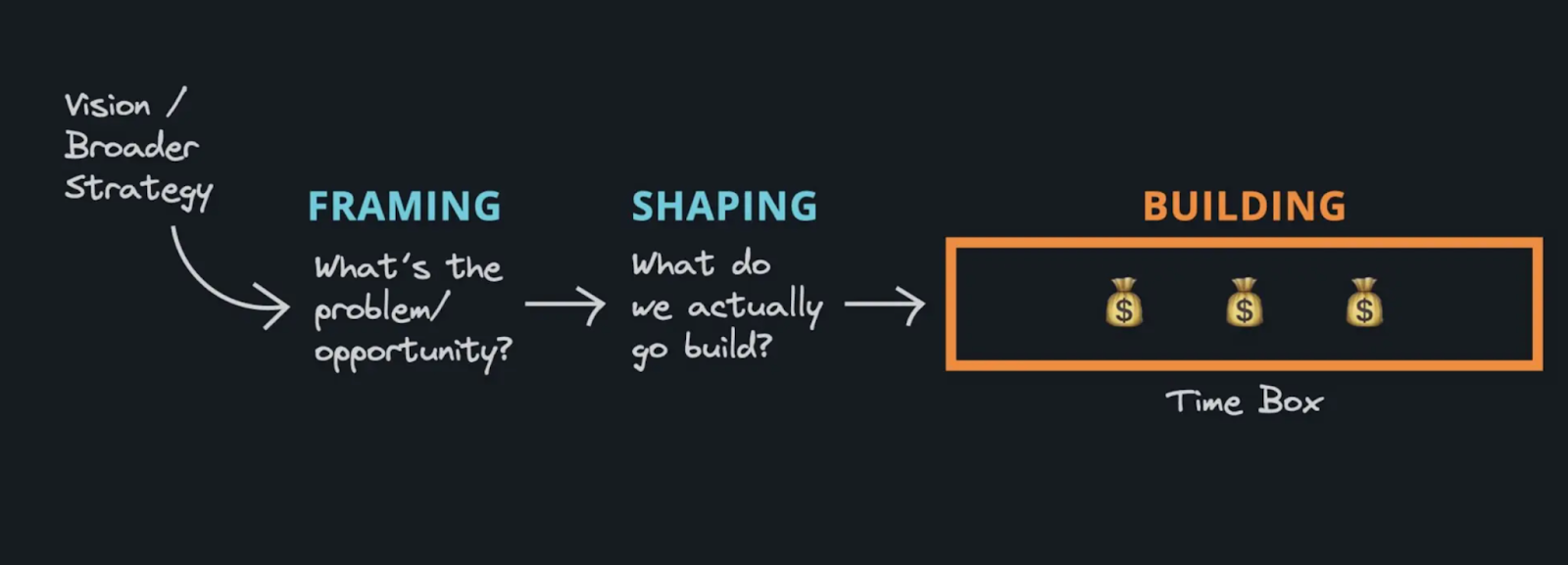
• Framing: This is the upstream work, focused on the demand side. Framing means narrowing down the problem or opportunity, understanding the customer viewpoint, and figuring out the “itch that we’re trying to scratch”. This is a strategic focus.
• Shaping: This follows framing and is on the solution side. Shaping involves creating the building plan or concept, what you are actually going to build. By clearly defining the frame (the problem), you gain clarity on what is important to do next, which then informs the solution (the shape).
“So when we talk about hard conversations, one of the hardest things is to be able to push back on this in a way that feels like progress for everybody.”
2. Commit to Time
The foundation of effective product development lies in defining a strategic time commitment that balances scope and completion.
Ryan argues that development time must be viewed as finite and projects must have a definitive end. He contrasts this with common practices:
- Open-ended projects often result in a “blank check”, leading to a never-ending, dragging effort.
- The two-week “sprint” is often dismissed as lacking strategic relevance.
“This two week sprint is an implementation detail of the scrum sausage machine. You know, it’s just how the machine works. It’s not a strategic unit of time”.
Instead, Ryan proposes a larger, strategic block of time, such as a six-week block, which is “big enough that we can actually finish something that works, that scratches an itch, and it’s small enough that we can see the end from the beginning, and we can actually make a commitment that it’s going to be over.”
3. Flip to the Demand Side (Framing) to Identify The True Problem
Requests often arrive as proposed solutions (the supply side), such as “we need notifications”or “we need a calendar”.
To have this hard conversations Ryan advises flipping the perspective to the demand side:
• Demand side asks: What is the problem? What are people struggling with? Why is now the right time?
• Supply side refers to: What are we building? (The solution idea).
4. River Crossing to Understand Customer Motivation
Ryan suggests a mental picture, or analogy, to guide these discussions: the river crossing.
The person making the request is on one side (the current context), trying to get to the other (the desired outcome). The request itself (e.g., “I need a calendar”) is just the suggested bridge.
The goal of framing is to anchor the conversation in reality:
• Context (Current Reality): What is going on? What are people feeling today? What is not working?
• Outcome (Desired Progress): If things were different, how would we know? How would we be able to tell if things were better?
By focusing on the context, teams can find simpler solutions. For instance, a request for a full calendar was reframed after realizing the core problem was the inability to see empty space (availability) for scheduling, leading to a much simpler concept called the dot grid.
“So sometimes completely ignoring the thing that we think that we want, and redefining the problem gets us closer and faster to that original thing even.”
5. The Frame is the Macro Unit Test
Clear framing provides the criteria for success and completion for the development team. Without a clear frame, when technical difficulties arise, teams are unable to make trade-offs and, instead, often resort to boiling the ocean, causing the scope to constantly expand.
The frame acts as a macro unit test for the entire project, enabling teams to judge when the solution approach (the shape) needs to be adjusted.
Ryan also highlights a quote (borrowed from Bob Moesta), emphasizing the importance of scope control in relation to time commitment: “You can’t put 10 pounds of dirt in a five pound bag”.
“I want to point out that when we’ve narrowed down the problem, when we’ve done that framing work, it’s not only helping us to get to a simpler solution idea. It’s not only helping us to spend less time and still scratch the itch. It’s also a big help when we’re inside of the build of the time box, when the team is actually supposed to be working on this and building”.
6. Product Management’s Strategic Focus is Framing
During the build phase, development teams need clarity across three levels of altitude:
1. Frame: The problem/itch being scratched (Highest altitude).
2. Shape: The concept of what is being built.
3. Implementation: The code and design details (Lowest, most concrete).
This elevation allows builders to make creative decisions and trade-offs.
At the end of his talk, Ryan addressed the roles within the organisation. While Product Managers (PMs) often aspire to set strategy, the big picture strategy belongs at the exec level.
The PM’s most impactful role is often the framing work: narrowing down the problem, understanding the context, and articulating the pain. This division of responsibility is crucial because PMs often lack the executive authority to redefine the win or say no to complex scope expansions when a project becomes significantly harder than expected.
Ryan’s talk was a reminder that clarity isn’t a luxury in product development, it’s the foundation. When we frame problems well, the hard conversations get easier, teams align faster, and the work finally starts to feel meaningful again.
It leaves us asking an important question: Where are we confusing motion for progress?
And maybe that’s exactly where we need to begin. Watch Ryan’s talk and share your thoughts.